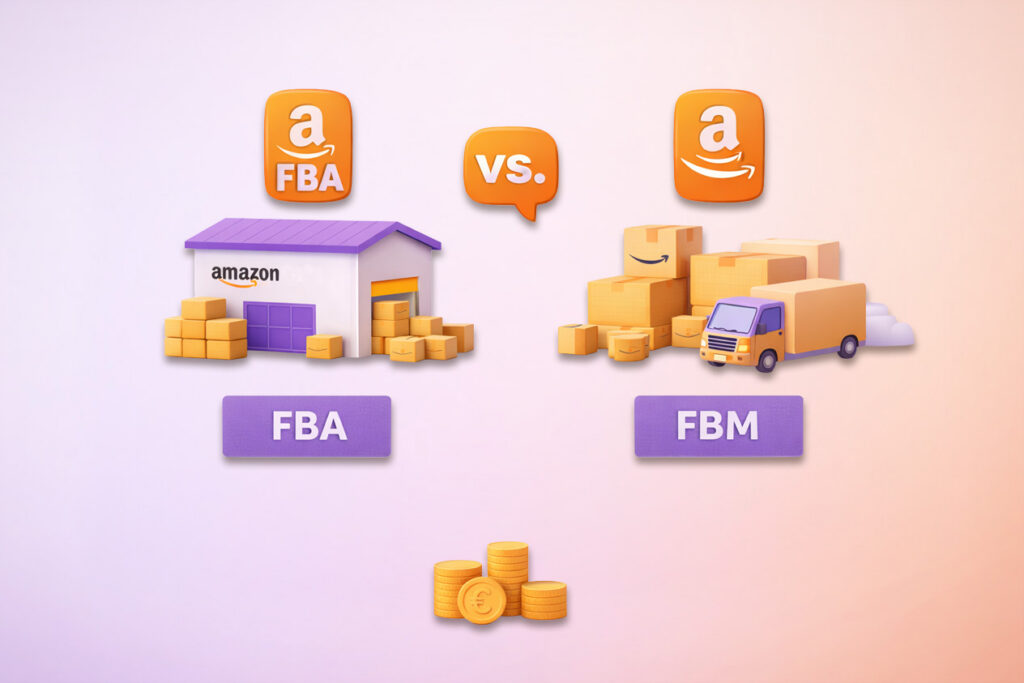
FBA or FBM? This decision is no longer a mere logistics question – it’s strategic. It equally affects costs, margin, visibility, and Buy Box chances.
In this article, you’ll find a structured comparison of both fulfillment models—with concrete decision aids for different seller types and a look at the hybrid model that many successful merchants prefer today.
Basics: FBA and FBM Overview
Anyone selling on Amazon faces a key strategic decision early on: FBA or FBM? At its core, it’s the question of whether you manage logistics processes yourself or outsource them to Amazon.
With FBA (Fulfillment by Amazon), Amazon takes full responsibility for storage, shipping, packaging, customer service, and returns processing for you.
FBM (Fulfillment by Merchant), on the other hand, means you carry the responsibility for these processes yourself—either managed internally or via an external logistics provider.
The two models differ not only in terms of logistics costs and operational effort, but also in aspects like scalability, Buy Box chances, and margin. Many successful sellers now rely on a combination of both approaches. The following article highlights the main differences and helps you find the right fulfillment model for your business setup.

FBA vs. FBM on Amazon: Choosing the right fulfillment model influences your costs, margin, Prime status, and Buy Box chances—making it one of the most important strategic decisions for any Amazon seller.
Product Storage
FBA
Goods are sent directly from the supplier or your own warehouse to Amazon’s fulfillment centers. Amazon handles inventory management and distribution within its own logistics network. You only need to organize shipment according to Amazon’s requirements. The biggest advantage for sellers is easy scalability; however, products with a slow sell-through rate can become costly due to storage and long-term storage fees.
FBM
The goods remain in your own warehouse or with an external fulfillment partner. You retain full control over inventory quantity, storage, and packaging materials. Flexibility is high, but the organizational effort and demands on internal processes increase as well.
Order Processing
FBA
Incoming orders are automatically processed by Amazon. This covers picking, packing, and the entire shipping process. Amazon ensures each order reaches the customer as quickly as possible. There’s no operational effort for you, even with high order volumes.
FBM
Order processing takes place in your own warehouse or via service providers. You pick, pack, and ship orders yourself. This enables, for example, branded packaging and customized processes. At the same time, reliable workflows and sufficient resources are essential for keeping delivery times and reporting tracking numbers to Amazon.
Delivery Time
FBA
Sellers benefit from Amazon’s comprehensive logistics network. Delivery times are generally very short and products are automatically Prime-qualified. This clearly boosts conversion rates and improves chances of winning the Buy Box.
FBM
Delivery speed depends on your own shipping performance. Processing and shipping times can be set individually per product and ZIP code region. Prime by Seller* also enables the Prime badge, but it requires high reliability. Without this program, longer delivery times may reduce willingness to buy.
*We cover this program in a separate blog article, which you can find here.
Returns
FBA
Amazon takes care of the entire returns process. Items are inspected, categorized, and—depending on their condition—either restocked or classified as unsellable. For items that can’t be reused, Amazon offers options such as return or disposal. This saves you time and effort, but gives you less control over the state of the returned items.
FBM
Returns are sent directly to you or your fulfillment partner. This gives you full transparency over the condition of the returned goods and allows for individual decisions, such as goodwill, refurbishment, or restocking. However, the manual effort is higher since all steps must be organized and documented yourself.
Customer Service
FBA
Amazon handles customer service for shipping, delivery, and returns. This relieves you in day-to-day operations and ensures consistent service quality. However, your influence over communication is limited, which restricts individual support or brand-specific messaging.
FBM
With FBM, customer service is entirely your responsibility. This allows for personal support, individual solutions, and targeted brand communication. However, Amazon policies must still be followed—especially the requirement to respond within 24 hours, including weekends and holidays. This demands structured processes, reliable systems, and sufficient resources.
Subscribe to our newsletter and receive fresh updates every two weeks.
Cost Structures Compared
Besides the points above, FBA and FBM mainly differ in their cost logic. Expenses arise at different stages and can impact margins differently, depending on the product type.
FBA Costs
Amazon charges fees for storage, shipping, packaging, and returns based on a rate card. Fees are calculated according to weight and volume and are regularly adjusted. You need to keep an eye on price changes. Additional costs can arise due to long-term storage fees if products don’t sell quickly enough. Precise stock management is crucial to avoid holding too much or too little inventory. FBA is especially attractive for small, lightweight, and frequently ordered products.
FBM Costs
With FBM, costs arise for your own storage space, staff, fulfillment partners, packaging material, shipping, and software. These expenses are more flexibly manageable since you can individually design your processes. FBM is especially worthwhile for bulky, heavy, or low-margin products where FBA fees are disproportionately high.
Strategic Differences Between FBA and FBM
The choice of fulfillment model influences not only the cost structure, but also directly impacts visibility, customer perception, and operational performance. Key questions include: How reliable is the delivery? How quickly do orders reach the customer? And how well are shipping, returns processing, and customer service coordinated?
Shipping Speed, Prime Status, and Conversion Rate
FBA
Products shipped via FBA automatically receive the Prime badge and benefit from fast delivery. Orders are typically delivered within one to two days, sometimes even on the same day. This fast shipping promise not only increases potential buyers’ trust, but also directly improves the conversion rate. The chances of winning the Buy Box also increase significantly since Amazon factors shipping quality into the Buy Box evaluation.
FBM
With FBM, you are entirely responsible for shipping quality. You must ensure delivery times, reliability, and tracking yourself. Achieving a Prime badge is only possible through the “Prime by Seller” program, which has strict requirements regarding shipping speed, punctuality, and customer satisfaction. Without Prime status, longer delivery times negatively impact visibility and conversion.
Inventory Control and Flexibility
FBA
Inventory is stored in Amazon’s fulfillment centers and automatically distributed across various warehouses. While this enables fast delivery times, it limits transparency. You need to monitor stock changes closely to avoid out-of-stock situations or unnecessary long-term storage fees.
FBM
Your inventory remains in your own warehouse or with an external fulfillment partner. You retain full control over quantities, restocking, and inventory strategy. This enables flexible planning for seasonal fluctuations or multi-channel sales. At the same time, the organizational effort required for inventory management and warehousing increases.
Internationalization
FBA
Amazon offers an efficient infrastructure for cross-border trade with programs such as Pan-European Shipping (Pan-EU) or the European Fulfillment Network (EFN). Storage, shipping, and delivery take place via Amazon’s fulfillment network, which shortens delivery times and enables Prime status in multiple countries.
FBM
With the FBM model, you must organize international shipping entirely yourself—including customs clearance, selecting shipping service providers, and returns solutions. While this offers maximum control, it is significantly more complex and resource-intensive, especially for multiple target markets.
Branding and Packaging
FBA
With FBA, shipping is done in standardized Amazon boxes with no influence on the external appearance. Custom branding such as branded packaging or special unboxing experiences is not possible. This can limit brand presence—especially for premium or D2C brands that aim to deliver a high-quality buying experience.
FBM
FBM gives you full creative freedom over packaging and brand communication. You can use branded boxes, personalized inserts, or custom packaging concepts. This strengthens brand identity, differentiates you from competitors, and can positively impact repeat purchases and customer loyalty.
Omni-Channel Opportunities
FBA
FBA is primarily designed for selling on Amazon. While Amazon does offer Multi-Channel Fulfillment (MCF) to use inventory for other sales channels as well, this comes with limitations and additional costs. Therefore, the flexible integration of multiple channels remains limited.
FBM
With FBM, you retain full control over your inventory and can easily use it across different channels. Whether Amazon, your own online shop, other marketplaces like eBay or Kaufland, or even brick-and-mortar stores: your inventory can be flexibly allocated to all sales channels. This increases reach and simplifies centralized inventory planning.
FBA vs. FBM: Decision Aids for Different Seller Types
The right fulfillment model depends on your structure, goals, and product range. Both approaches are suitable for certain seller profiles.
When FBA Makes Sense
- Companies that want to outsource logistics and focus on their core business
- Sellers who want to benefit from the Prime badge, higher conversion rates, and better Buy Box chances without extra effort
- Merchants looking to scale or expand internationally
- Products with high sales volume and steady demand
- Items that are lightweight and compact, making them inexpensive to ship
- New sellers who want to get started quickly without building their own shipping processes
When FBM is the better choice
- Merchants with their own warehousing and shipping logistics or close fulfillment partners
- Products with large volumes or special requirements for packaging and handling
- Products for which FBA fees would significantly reduce the margin
- Brands looking to use custom packaging or specific shipping processes
- Product ranges with high return rates and the desire to inspect or refurbish returns in-house
Advantages of the hybrid model
Experienced sellers are increasingly combining both approaches to reduce risks, optimize costs, and respond flexibly to market dynamics. The hybrid model leverages the strengths of both fulfillment types, creating a robust, scalable solution.
- Optimized cost structure by targeted use depending on product, margin, and weight
- Flexibility to handle seasonal fluctuations or short-term promotions
- Reduced out-of-stock risks, as inventory is secured across both FBA and FBM simultaneously
- Protection against internal resource bottlenecks, e.g., staff shortages in the warehouse
- Increased Buy Box chances, as product availability and shipping options are broader
- Use of FBM to avoid long-term storage fees for slow-moving items
- Both brand building in the FBM channel and scalability via FBA possible
- Ability to cover certain countries with FBA while serving other regions via FBM
The result is greater stability in day-to-day operations, better Buy Box opportunities, and a balanced equilibrium between scalability, cost efficiency, and brand management.
Conclusion
The decision between FBA and FBM represents a fundamental strategic crossroads for Amazon sellers, as it largely influences costs, effort, performance, and ultimately the chances for the Buy Box. FBA offers the great advantage that Amazon handles the entire logistics process, including shipping, returns, and customer service, and the stored products automatically benefit from the Prime badge. In contrast, FBM stands for maximum flexibility and control: you keep responsibility for inventory and shipping and can customize your branding. In addition, FBM often brings lower costs for bulky or heavy products.
Ultimately, this choice is not a strict either-or. Combining both models enables a flexible fulfillment strategy tailored to your business model that can be effectively adapted to market requirements – and as a result, is often more sustainable and successful than relying exclusively on FBA or FBM.
As a partner to numerous brands utilizing both FBA and FBM strategies in parallel, we are familiar with the mechanisms, levers, and challenges of the various fulfillment models in detail. Whether you want to build FBA, FBM, or an efficient hybrid model, we are happy to support you with analysis, planning, and operational implementation—with the clear goal of maximizing revenue and margin sustainably. Get in touch!