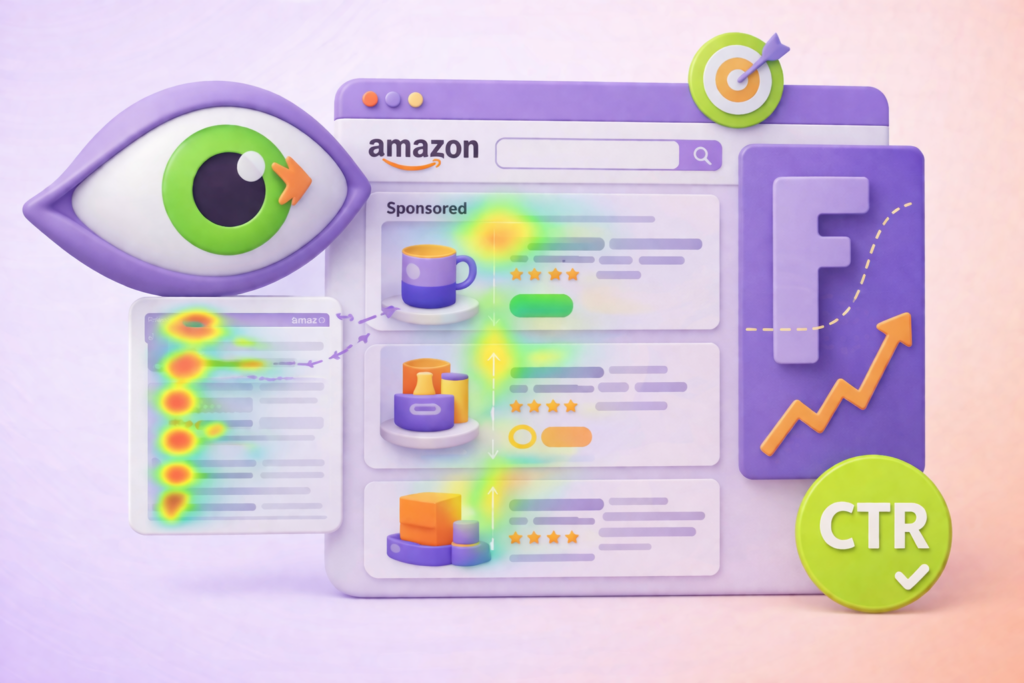
In the jungle of Amazon results pages, the first impression often determines whether a product is a hit or a flop. An eye-tracking study by Valuezon and Hochschule Fresenius has, for the first time, revealed what draws consumers’ attention – and how you can leverage this insight for better sales.
The study reveals a so-called “adjusted F-pattern” – and makes it clear that advertising on Amazon is not filtered out by consumers as strongly as it is on Google. With one exception.
Basics of the Amazon Eye-Tracking Study
Eyetracking is not entirely new – the first studies for Google were conducted as early as 2006, which uncovered the so-called F-pattern: Users would still read the titles of the top results in full, but became increasingly likely to skim the text as they scrolled further down. Ten years later, a repeat of the study showed that consumers had learned to ignore ads, which are usually placed in the first two rows, and only began their usual reading behavior below – the “adjusted F-pattern”.

50% of the total fixation duration by all participants on the search results page was on main images. What your product communicates at first glance determines whether it gets a click or is simply scrolled past.
Valuezon, together with Prof. Wahrenberger from Hochschule Fresenius, conducted such an eye-tracking study specifically for Amazon to answer the following research questions:
- Which elements of an Amazon offer are perceived by consumers – both on the search results page (SERP) and on the product detail page (PDP)?
- How intensely and in what sequence are these elements perceived?
- Does it make a difference whether I am in a complex decision-making process (high involvement) or a simple one (low involvement)?
- Can I optimize my offer based on these insights so that it stands out from the crowd and achieves a higher CTR and CR?
To differentiate between high vs. low involvement in the Amazon context, we had the participants look at both portable Bluetooth speakers (more complex buying decision process) and water bottles (simpler buying decision process).

Fig. 1: The F-Pattern – Source: Jacob Nielsen (2006), Usability (2016)

Fig. 2: Sample heatmap of two different SERPs from the study

Subscribe to our newsletter and receive fresh updates every two weeks.
Insights into Information Behavior on SERPs
Regardless of the level of involvement, it was observed that the following elements on an Amazon search results page attracted particularly strong attention:
- On the product, recognizable logos – regardless of whether the associated brand is well-known
- Interesting special features of the product, which were clearly visible on the main image (e.g., innovative solutions or bonus items)
- The well-known Bestseller label – regardless of whether the subcategory matches the search query
- Products shown in the grid view to the right of a bestseller product – a fact that confirms the F-pattern on Amazon
- A special customizing option for a product – probably because viewers briefly consider how this could be customized in their own case
It was also surprising to learn what did not attract much attention:
- The titles of product offers – only about a third of the titles were even noticed, and only about one in five was actually read
- Special effects on the main images, such as splashing water, which also do not comply with Amazon’s guidelines for offer images
- The Sponsored label for Sponsored Product Ads
- Sponsored Brands Headline ads, which consumers already recognize and ignore as advertising – the adjusted F-pattern

Fig. 3: Adapted F-pattern on Amazon – Sponsored Brands Headline ads are ignored
The last two points are particularly interesting for advertisers on Amazon. Sponsored Products formats, unlike on Google, are still perceived as organic recommendations by the platform and, in 90% of cases, are explicitly fixed and noticed in top-of-search placements. In contrast, Sponsored Brand Headline formats, although positioned even more prominently above, were only noticed by two-thirds of consumers. One third already ignored them and began absorbing information only below.
Learnings for Amazon Sellers
“I deliberately paint the noses crooked so that people are forced to look at them.” – Pablo Picasso
Amazon sellers, of course, want their offers to stand out from the crowd and to force consumers—like Picasso—to pay attention to their product. Achieving this is not easy. It already requires a certain amount of creativity during the development of a product. According to Amazon, only the product itself should be shown in the main image. Interestingly, 50% of the total fixation duration by all test subjects on SERPs was focused on these main images. This is also the reason why successful projects at Valuezon often start with so-called SMU workshops, where the ideal Amazon product for each category is developed.
Professional, creative, and skillful product photography can also help make a product stand out more, even within Amazon’s guidelines.
The remaining elements, such as bestseller labels or positioning within a SERP, can only be influenced to a limited extent.
It is also interesting how little Sponsored Product Ads are perceived as advertising. This underlines the importance of top-of-search placements, something we can confirm from our daily Amazon Advertising work—supported by our BI tool Valuezon Performance Cockpit. Knowing the exact profitability for every search term and thereby getting the most out of each individual PPC bid becomes a critical success factor on Amazon.
Further Results on PDP and Images
When looking at product detail pages and offer images, we also distinguished between situations of medium to high involvement and those with low involvement. Surprisingly, it was not the level of involvement that made a difference, but rather the sheer amount of information available. Thus, we observed interesting differences in the way consumers absorb information between optimized and content-rich Amazon listings and more simplistic representations of offers.
You can find out more in our second article on eye tracking on Amazon.
Conclusion
Even though the qualitative research approach of eye tracking is not suitable for deriving universally valid findings, the study did provide exciting food for thought, confirmed some of our hypotheses, and prompted us to further optimize our clients’ offers—with A/B tests and similar approaches—especially their main images, so that they stand out from the crowd and are clicked more often than others.
An old piece of wisdom is thus confirmed: Everything starts with an exceptionally good product!
Frequently Asked Questions (FAQ)
Are the results transferable to my category?
By considering two categories with different extensive purchasing decision processes, we tried to achieve a more generalizable set of findings. Nevertheless, the results are certainly not transferable to every category.
Do the findings also apply to the use of the Amazon Mobile App?
Because the layout of search results pages as well as product detail pages is designed differently on mobile devices, and user behavior is also completely different (e.g., swiping instead of scrolling), the results are only very limitedly transferable to mobile. Therefore, our goal is to conduct a mobile eye tracking study on Amazon in the near future.
How much does an eye tracking study for my brand cost?
The costs vary depending on the experimental setup—i.e., how many subcategories, how many products, and which research questions are the focus. However, you should expect costs in the range of 7,000 to 10,000 EUR. If several brands are bundled in a single study, more efficient solutions may also be found.
What are the most important factors for offer optimization?
The study showed that information-seeking behavior on Amazon is very heterogeneous, so all content elements should be fully utilized when creating an offer. However, two elements were very dominant across the board: first, images and second, reviews. Therefore, special attention should be paid to sales-promoting images and to investing in a customer-friendly service as well as good after-sales processes.