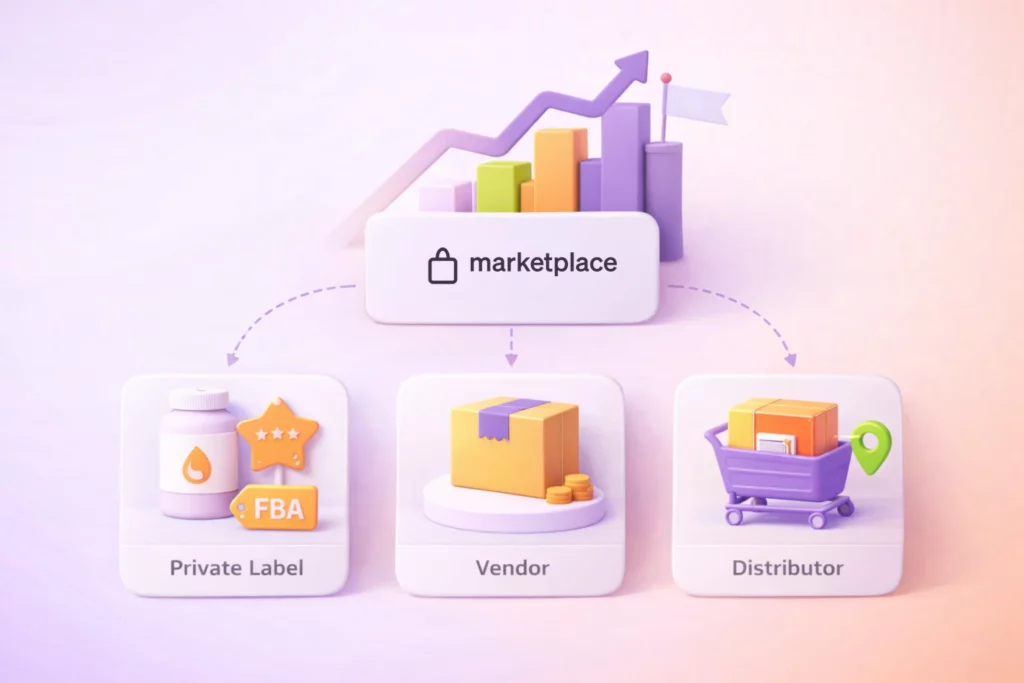
Amazon offers sellers three basic sales approaches: Private Label FBA, the Amazon Vendor program, and the distributor approach. Each model has its own dynamics, advantages and disadvantages – and suits different company types.
This article will help you choose the optimal path to business success on Amazon.
Private Label FBA Sellers
The Fulfillment by Amazon (FBA) program, launched in 2006, has become a cornerstone of the Amazon business model. It offers sellers a comprehensive logistics solution including storage, packaging, shipping, and customer service – thereby significantly simplifying global distribution.

The right Amazon sales model depends on your goals: If you want brand control, choose FBA – if you want to scale without much effort, the distributor approach is often the smarter solution.

What is the FBA Seller Approach?
The Private Label FBA approach allows you to design your own branded products and sell them directly on Amazon. Sellers use Amazon’s FBA service, which takes care of storage, packaging, shipping, and customer service. This model stands out for its ease of use and efficiency: You can focus on product development and branding, while Amazon handles operations. The uniqueness lies in the combination of individual brand control with Amazon’s powerful logistics and distribution channels – including simple international sales with just a few clicks.
Advantages and Disadvantages of FBA
Advantages:
- Access to Amazon’s broad customer base: You reach millions of customers worldwide.
- Reduced logistics effort: Amazon handles storage, shipping, and customer service.
- Easy scaling: The FBA model makes expanding into new markets (internationalization) much easier.
Disadvantages:
- Dependence on Amazon: You are subject to Amazon’s policies and fee structures.
- Competitive pressure: High competition levels can reduce margins.
- Brand control: Limitations in customer interaction and brand presentation.
- Resource and expertise requirements: Successful management requires investment in product development and marketing as well as an in-depth understanding of the Amazon marketplace.
Practical example: An entrepreneur builds his own bamboo brand using Amazon FBA. He uses Amazon’s global sales channels to reach a broad audience while focusing on product quality and brand development. Despite the challenge of competing with established brands, he manages to build a loyal customer base and establish his products on the market through targeted marketing and leveraging Amazon SEO.
Who is Amazon FBA suitable for?
The Private Label FBA model is ideal for ambitious entrepreneurs and companies looking to grow quickly and build their own brand with minimal logistical effort. It is especially suitable for start-ups and SMEs seeking an efficient way to enter the market with limited resources, for innovators interested in focusing on product development, and for global sellers aiming to expand their reach to international markets.
Subscribe to our newsletter and receive fresh updates every two weeks.
Direct Sales to Amazon as Vendor

Amazon’s Vendor program, an established part of the Amazon ecosystem, gives manufacturers and brand owners the opportunity to sell their products directly to Amazon. It was originally developed to create a stronger relationship between Amazon and established brands.
How does the Amazon Vendor business work?
With the Vendor model, manufacturers and brand owners sell their products directly to Amazon, which then resells to end customers. In contrast to the FBA model, where sellers retain control over the sales process, Amazon acts as the main seller. Pricing, marketing, and promotions are managed by Amazon. Vendors are primarily suppliers – while in the FBA model, sellers remain independent merchants.
Advantages and Disadvantages of the Amazon Vendor Business
Advantages:
- Easy handling: Selling directly to Amazon simplifies logistics and distribution.
- Brand presence: Products benefit from Amazon’s marketing and customer trust.
- Predictable revenue: Fixed prices and order quantities provide planning security.
Disadvantages:
- Loss of control: Prices and marketing are mainly determined by Amazon.
- Dependency: Business success is closely tied to Amazon’s decisions.
- Potentially lower margins: Amazon purchases at wholesale prices, which can reduce profit margins.
Practical example: A medium-sized kitchenware manufacturer chooses the Amazon Vendor Program. The partnership increases the visibility of its products and simplifies the distribution chain. However, it has to give up control over pricing and adapt to Amazon’s order quantities and delivery times. Although sales remain steady, margins and production plans must be continuously adjusted to meet Amazon’s requirements.
Target Group for Amazon Vendor
The Amazon Vendor Program is particularly suitable for established manufacturers and brands with stable, high-volume production. It is ideal for companies that are willing to give up control over prices and marketing to Amazon in order to benefit from its extensive distribution network and customer base. Especially advantageous for suppliers with high-demand products who expect steady demand and high sales volume.
Selling via Third-Party Sellers or Distributors

Selling through third-party sellers or distributors on Amazon represents an alternative strategy where merchants have their products offered by independent sellers on the marketplace. This method provides a differentiated approach compared to direct Amazon sales models and has its own dynamics.
The Distributor Approach at a Glance
In the distributor model, independent traders or third-party sellers sell products on behalf of the manufacturer on Amazon. Unlike FBA, where sellers list their own products, here the responsibility for sales, pricing, and often marketing is handed over to external partners. This allows manufacturers to focus on production while third parties handle the challenges of e-commerce management.
Advantages and Disadvantages of the Distributor Approach
Advantages:
- Reduced effort: Manufacturers don’t need to handle sales processes or Amazon-specific requirements.
- Market expansion: Distributors can open up new customer groups and markets.
- Expertise: Benefit from the e-commerce experience of a distributor.
Disadvantages:
- Lower margins: Amazon’s cost structure is different compared to offline sales channels, changing the margin profile.
- Loss of control (depending on third party): Limited influence over brand presentation and customer relationships.
- Dependency: Potential risks when choosing an unreliable partner.
Practical example: A perfume licensee chooses the distributor approach to sell on Amazon. They can focus on product development and quality while the distributor handles marketing, sales, and customer service. Despite lower profit per sale, they benefit from broad market coverage, continuous product availability, and reduced complexity in the sales process.
Which Merchants Benefit from Collaborating with Third-Party Sellers?
The third-party seller approach is particularly suitable for manufacturers and brands who want to focus on their core competencies, such as product development and manufacturing, without getting involved in the complexities of direct online sales. Ideal for companies that either do not have the resources or expertise for effective online marketing, or that deliberately choose to separate production from sales. This is also an effective path for small to medium-sized companies looking to rapidly expand their reach.
Comparison and Summary of All 3 Approaches
The three sales strategies on Amazon – Private Label FBA, Amazon Vendor, and sales via third-party distributors – offer different perspectives and opportunities. Private Label FBA enables you to establish a brand and rely on Amazon’s logistics network, while the Vendor program represents a direct sales partnership with Amazon as the main seller. The distributor approach is ideal for manufacturers who want to leave distribution and marketing efforts to external professionals.
Each model targets specific business requirements: FBA for private label development and global reach, Vendor for consistent sales under Amazon’s management, and the third-party approach for a focused production strategy. The choice should be based on your business orientation, available resources, and long-term goals. Success in any of these models requires flexibility in market behavior and a willingness to invest in the chosen sales strategy.
Valuezon Distributor
At Valuezon, we understand that selling on Amazon can be complex. That’s why we offer a comprehensive solution for sellers who want to gain a foothold on this vast marketplace without getting lost in the depths of e-commerce. As a partner and distributor, we handle the entire process – from product placement and sales strategy to customer service. Our success is based on data-driven approaches and advanced software solutions that increase revenue and expand your brand presence. Place the Amazon sales challenges in our hands and focus instead on what you do best: your business. With Valuezon as your partner, you’re setting yourself up for sustainable growth and success on the largest European Amazon marketplaces.
You can find more about our distributor offering here.
Frequently Asked Questions (FAQ)
How does Valuezon support sellers with selling on Amazon?
Valuezon, as a distributor, handles the entire sales process on Amazon, including product placement, sales strategies, and customer service. We use data-driven strategies and software solutions to achieve revenue growth and greater brand awareness, so you can focus on your core business.
What is the difference between the Private Label FBA approach and Amazon Vendor?
The Private Label FBA approach enables you to sell your own products using Amazon’s logistics, while the Vendor program means that products are sold directly to Amazon, which then acts as the retailer.
Who is selling through third-party providers or distributors on Amazon suitable for?
This model is ideal for manufacturers who want to focus on production and leave sales and marketing processes to external experts to succeed on Amazon.
What challenges does the Private Label FBA approach bring?
The challenges include dependence on Amazon’s policies and fee structures, strong competition, and the need for resources and expertise in product development and marketing.
Can I use the Amazon Vendor approach as a small or medium-sized company?
The Vendor approach is best suited for established manufacturers and brands with stable and high-volume production who are willing to give up control over pricing and marketing to Amazon.