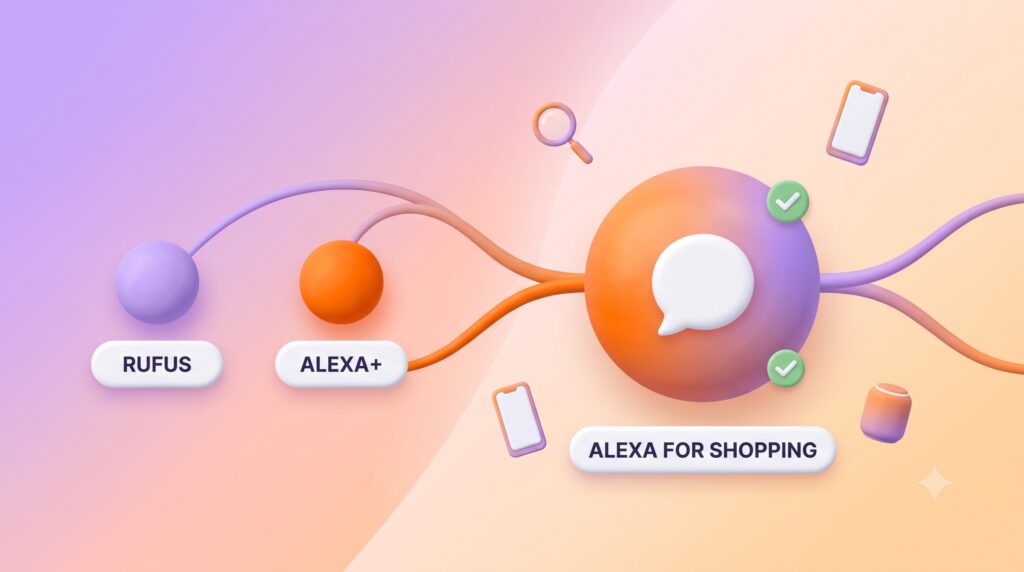
On May 13, 2026, Amazon discontinued the Rufus brand and merged the shopping assistant with Alexa+ to create Alexa for Shopping. At the time of this article, this applies exclusively to the US; in Germany, the assistant is still called Rufus. It sounds like a major change, but it’s mostly just a new name. The technology powering it remains the same, as does all the work you’ve done to ensure your visibility in AI search. Here you’ll learn what Alexa for Shopping is, what’s really changing for sellers, when the assistant will launch in Germany, and how to prepare your listings now.
What is Alexa for Shopping?

Alexa for Shopping is Amazon’s generative AI shopping assistant. It answers product questions, creates comparisons, and provides personalized recommendations—right in the search bar, the shopping app, and on Echo devices. As of May 2026, Amazon has consolidated the previously separate Rufus and Alexa+ assistants under this brand.
At a glance:
- Alexa for Shopping is the successor to Rufus—not an entirely new system, but a rebrand with enhanced functionality
- It operates wherever customers shop: search bar, app, amazon.com, and Echo Show
- For brands, this means the assistant evolves from a beta experiment to a permanent feature of the Amazon interface
- To be recommended by the AI, you must optimize your product listing so the AI understands your product
Until May 2026, Amazon had two separate AI assistants: Rufus, the shopping advisor for product questions and comparisons, and Alexa+, the general speech AI on Echo devices. With the rebrand to Alexa for Shopping, both have merged into a single assistant with a unified shopper profile. Whether you’re searching on desktop, browsing the app, or asking your Echo Show, the same AI answers—one that knows what you last viewed.
For sellers, this means one big thing: the assistant is becoming more visible and more important. What started as an optional beta feature is now the standard way customers discover products. The logic behind it remains the same as with Rufus. If you’ve made your listings understandable for the AI, you’re already prepared for Alexa for Shopping.

Fig. 1: This is what Alexa for Shopping looks like in the US interface—the assistant takes your question in natural language. Screenshot: amazon.com (USA), July 2026, editorial use.
From Rufus to Alexa for Shopping: The Timeline
At a glance:
- February 2024: Rufus launches in the US as a beta shopping assistant
- October 2024: Rufus launches as a beta version in the German Amazon app
- 2025: Rolled out to all customers in Germany and Austria; available in the desktop browser from July
- May 13, 2026: Rufus and Alexa+ are merged into Alexa for Shopping, launch in the US
The path from experiment to standard was short. Amazon first launched Rufus in the US in February 2024, brought the beta to Germany in October 2024, and made the assistant available to all German and Austrian customers in 2025. From July 2025, Rufus was not only in the mobile app but also in the desktop browser. In approximately eighteen months, the user base grew to around 300 million people.
On May 13, 2026, the next step followed: Amazon retired the Rufus brand and combined the shopping assistant with Alexa+ into Alexa for Shopping. The launch took place first in the US, free for logged-in customers, within the search bar, shopping app, on amazon.com, and Echo Show. Amazon has not yet announced an official date for the launch in Germany. However, since Rufus has been available in Germany since October 2024, Alexa for Shopping is expected to roll out here next.
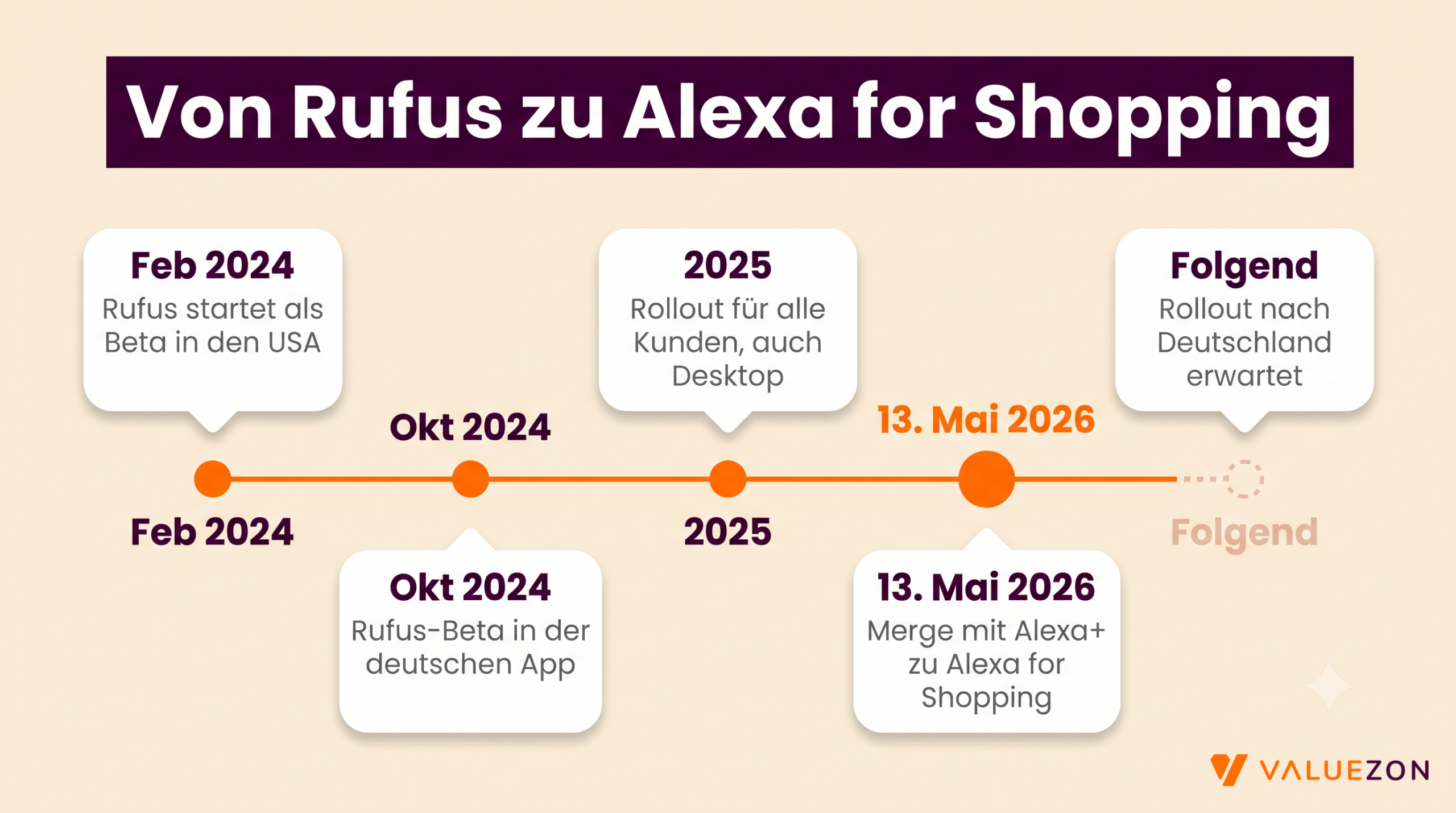
Fig. 2: From the US beta in 2024 to the merge with Alexa+ in May 2026. Alexa for Shopping’s rollout in Germany is expected to follow. Source: Valuezon, own illustration.

Subscribe to our newsletter for fresh updates every two weeks.
What changes for sellers, and what doesn’t
At a glance:
- Unchanged: the technology, data sources, and optimization logic
- New: a single name, a unified buyer profile across all devices, and agent-like functions
- New: significantly higher visibility, as the assistant becomes an integral part of search
- Consequence: Your groundwork for Rufus translates directly to Alexa for Shopping
The most important sentence for any seller is: You don’t need to learn anything new. Under the hood, it’s still the same system at work. A specialized shopping language model that uses Amazon Bedrock to select the best-fit model for each query, and a process known as Retrieval-Augmented Generation, where the AI assembles answers from real Amazon data instead of generating them freely. These data sources remain the same: customer reviews, Q&A, your listing text, A+ Content, product images, and the COSMO knowledge graph.
New is the unified experience. Instead of two separate assistants, there is now one name and a persistent buyer profile that accompanies users across web, app, and Echo. On top of that, there are agent-like features: the assistant can carry out planned actions, such as tracking prices and even making purchases autonomously when a target price is reached. And most importantly for sellers, your visibility increases. What was once a beta feature is now an integral part of Amazon search.
Unchanged is the optimization logic, and that’s the good news. Clear, quotable texts. Concrete numbers instead of marketing phrases. Consistency across all sources. And consistent, credible customer reviews. If you have already implemented this for Rufus, you’re ready for Alexa for Shopping. There’s no new optimization discipline—just a much bigger stage for the same work.
Where Alexa for Shopping runs—and why it matters
At a glance:
- The assistant is present at three touchpoints: search bar, shopping app, and Echo Show
- Around 300 million people have already used Rufus, the foundation of Alexa for Shopping
- Amazon estimates the additional annual revenue from the assistant at around $12 billion
- The more customers shop via AI, the more important it becomes to be recommended by it
Alexa for Shopping isn’t a single product you have to open—it’s a layer that sits atop the entire Amazon interface. Customers encounter it in three places: in the search bar on amazon.com, where they can ask natural language questions instead of entering search terms; in the shopping app as a chat companion while browsing; and on the Echo Show, where they can shop by voice. Across all three channels, the assistant recognizes the same customer.
The numbers show why this is significant. Rufus, the foundation of the new assistant, reached around 300 million users by 2025. Amazon CEO Andy Jassy estimated the additional revenue driven by the assistant to be about $12 billion per year. For you as a seller, this means: A growing portion of your potential buyers will ask the AI a question before viewing a product. Whether your listing appears in the response is determined by what the AI understands about your product.
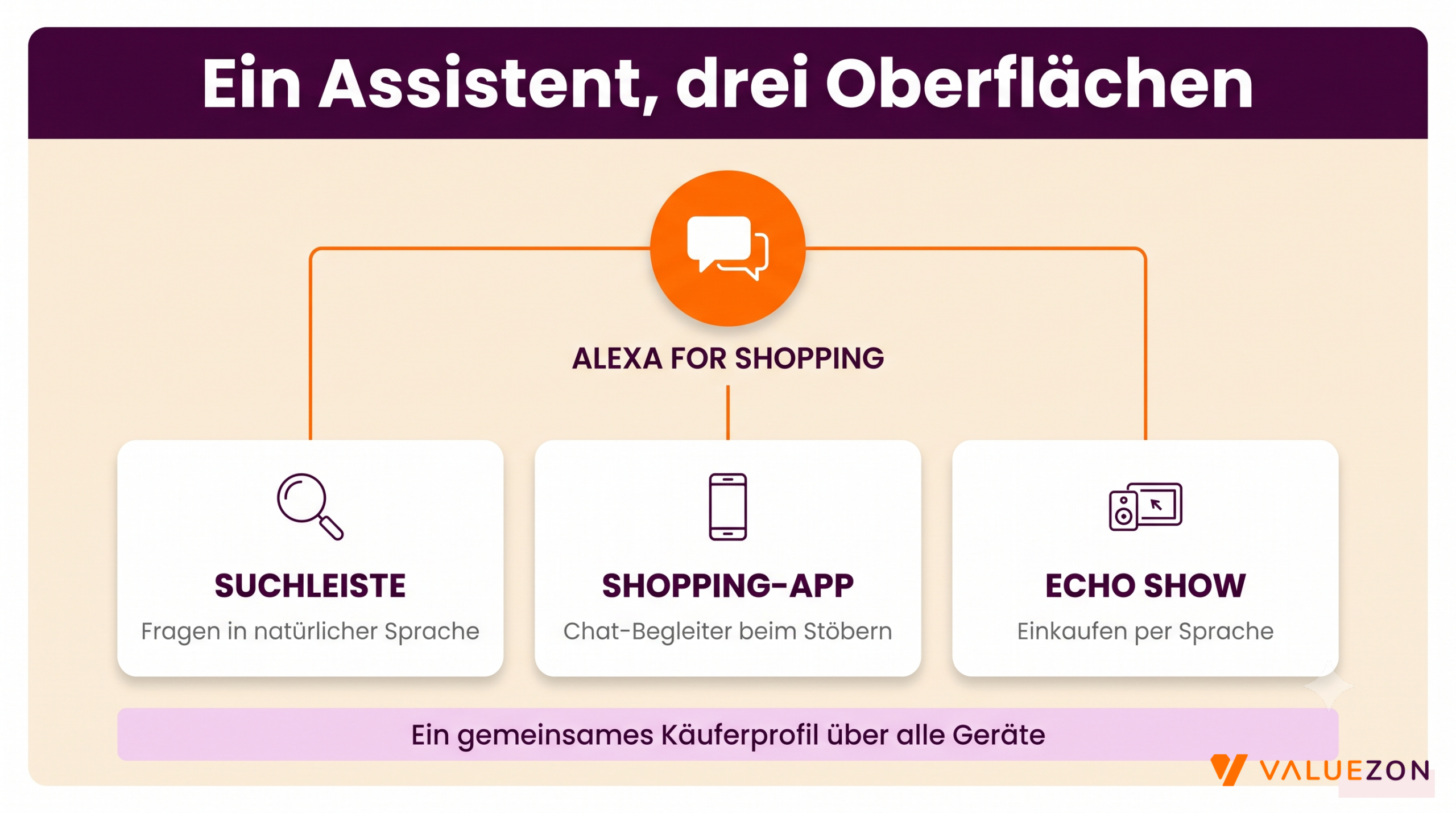
Fig. 3: One assistant, one buyer profile, three interfaces. Alexa for Shopping accompanies the customer across the search bar, app, and Echo Show. Source: Valuezon, own illustration.
How to make your listing AI-ready
At a glance:
- Write quotably: short, clear statements that the AI can use verbatim
- Use concrete numbers and facts instead of vague marketing phrases
- Keep all sources consistent: title, bullets, A+ Content, images, and Q&A
- Maintain your reviews, as they are especially trusted by the AI
Optimization for Alexa for Shopping follows the same principles as for Rufus and can be distilled to three levers. Write quotably: An AI assistant looks for clear, evidence-based statements that it can use directly in an answer—that means concrete numbers, measurements, run times, and materials, instead of marketing adjectives. Maintain consistency: Title, bullets, A+ Content, images, and the Q&A section must all state the same information; inconsistencies reduce visibility. Take care of your reviews: Reviews are viewed by the AI as independent experience data and, if in doubt, carry more weight than your own listing text.
We’ll show you exactly how to implement these levers step by step in our guide to the 10 Rufus Factors that optimize your listing for Amazon AI. The factors described there apply directly to Alexa for Shopping as well.
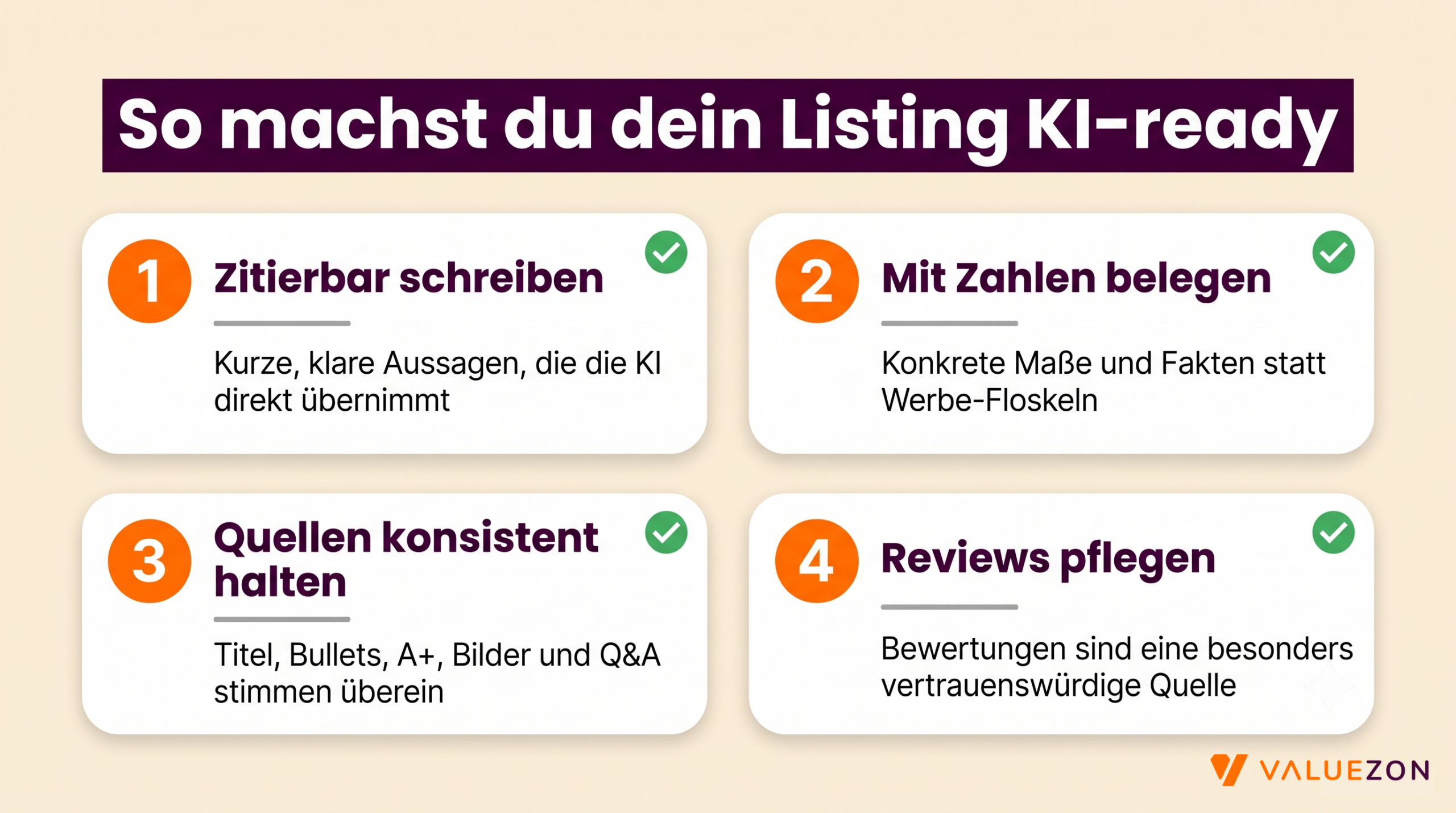
Fig. 4: Four levers for an AI-ready listing: write in a quotable way, support with numbers, keep sources consistent, and manage reviews. Source: Valuezon, own illustration.

Frequently Asked Questions about Alexa for Shopping
What is Alexa for Shopping?
Alexa for Shopping is Amazon’s generative AI shopping assistant. It answers product questions, creates comparisons, and provides personalized recommendations directly in the Amazon search bar, the shopping app, and on Echo devices. Since May 2026, Amazon has unified the previously separate Rufus and Alexa+ assistants under Alexa for Shopping.
Is Alexa for Shopping the same as Rufus?
Essentially, yes. On May 13, 2026, Amazon discontinued the Rufus brand and merged the shopping assistant with Alexa+ to form Alexa for Shopping. It is a rebranding and consolidation, not a technical shutdown. The core functionalities with retrieval-augmented generation and multi-model routing via Amazon Bedrock remain in place.
When will Alexa for Shopping launch in Germany?
The launch took place first in the USA. Rufus had been available in Germany in beta since October 2024 and was rolled out to all customers in 2025. The rollout of Alexa for Shopping in Germany is expected to follow, but Amazon has not yet announced an official date.
Do I need to re-optimize my listing for Alexa for Shopping?
No. If you have already prepared your listing for Rufus, you are also set for Alexa for Shopping. The optimization logic remains the same: quotable copy, concrete numbers, consistency across all sources, and consistent customer reviews.
What are the new agent capabilities?
Unlike the purely question-and-answer assistant Rufus, Alexa for Shopping can independently perform actions. These include planned tasks such as tracking a price and automatically purchasing once a predetermined target price is reached. So, the assistant not only answers questions but can also take actions in the buying process.
Sources
The information in this article is based on reporting about the rebrand on May 13, 2026 (CNBC, Amazon ditches Rufus chatbot, launches Alexa shopping agent, cnbc.com, as well as GeekWire, Amazon unifies Alexa+ and Rufus, geekwire.com), Amazon’s official introduction of the assistant (About Amazon, Meet Alexa for Shopping, aboutamazon.com), and technical background about its functionality (AWS Machine Learning Blog, How Rufus scales conversational shopping experiences, aws.amazon.com). Amazon does not publish official details regarding internal ranking algorithms. Statements about the weighting of individual signals are plausible model assumptions, not confirmed facts. Additional insights from Valuezon’s own optimization practice are also included.