
Amazon offers you numerous tools to target your ads even more precisely. Rule-Based Audiences from the Amazon Marketing Cloud (AMC) are based on defined rules and behavior patterns—and can be precisely utilized in the Amazon Advertising Console. In this article, we’ll show you how to create these audiences and use them successfully to significantly boost your campaign performance.
What are Rule-Based Audiences?

With Rule-Based Audiences, you can target your ads specifically to users who have taken concrete actions or shown certain interests—instead of targeting a broad audience and wasting budget.
A Rule-Based Audience is an audience defined by setting specific behavioral and demographic rules. Rather than targeting a general audience, you can aim your ads specifically at users who have performed certain actions or shown a particular interest.
These rules are based on data Amazon collects from its vast platform, giving you the opportunity to create highly relevant audiences. The data includes not only purchase history but also interactions with products, ad clicks, and much more.

Subscribe to our newsletter and receive fresh updates every two weeks.
How do Rule-Based Audiences work?
With Rule-Based Audiences, you can customize your audience based on different criteria and rules. Here are the most important features and functionalities available to you:
Behavior-Based Rules
You can specifically target people who have already interacted with your product—for example, users who have viewed a product but haven’t purchased it. Likewise, you can target users who have browsed certain categories or have already purchased similar products.
Product Interests and Purchase Behavior
You can specifically target users who show a particular interest in a product or who regularly buy similar products. Cart behavior can also serve as a basis—for example, users who have added a product to their cart but have not completed the purchase.
Data Integration
Amazon uses extensive data from its entire ecosystem—including Amazon.com, Prime Video, Amazon Music, and other platforms—to understand and analyze user behavior and preferences.
Advantages of Rule-Based Audiences
- Higher relevance and better conversion rate: By targeting the right audiences precisely, you increase the relevance of your ads. This leads to a higher click-through rate and ultimately a better conversion rate. If you target a user group that has already shown interest in your product or similar products, the likelihood of a purchase is significantly higher.
- Time and resource saving: Rule-Based Audiences enable automated audience targeting, saving you a lot of time. Instead of manually searching for the right audiences, you can let Amazon do the work. This saves resources and allows you to scale your campaigns faster and more efficiently.
- Reduced scatter loss: Since you’re working with targeted rules, you avoid wasted impressions. Your ads are only shown to users who are likely to be interested, leading to better performance and increasing the ROI of your campaigns.
- Precise adjustment of bid strategies: With Rule-Based Audiences, you can precisely tailor your bidding strategies to get the most out of your ad spend. You can increase bids for users with high purchase intent and lower bids for less relevant audiences.
How to Create Rule-Based Audiences
a. Access to Amazon Advertising: You need to have an Amazon Advertising account to create Rule-Based Audiences.
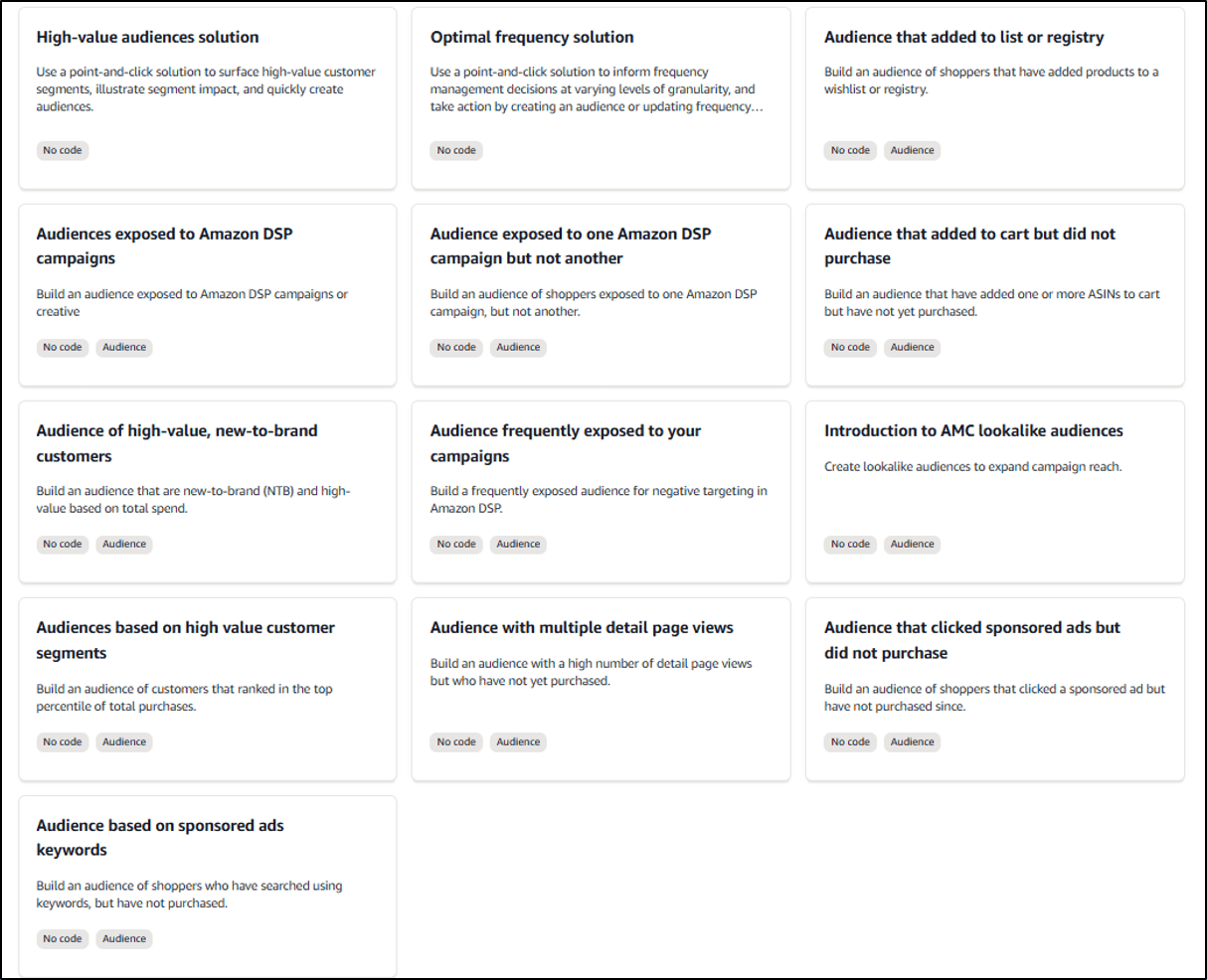
b. Select predefined audiences from Amazon in the AMC—or create your own by coding your query using SQL and thereby establishing your audience rule.
c. Once the audience has been created in the AMC, you can add it as a “Target Audience” in your advertising account under bid adjustments.
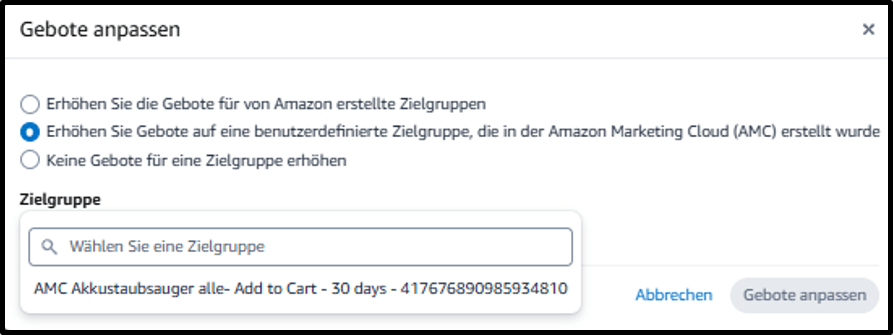
d. Ad delivery: Create the ads and select the newly created audiences. Amazon will then display your campaigns to these specific users.
e. Continuous optimization: Monitor the performance of your campaigns and regularly optimize the rules to increase effectiveness.
Example of a Rule-Based Audience
Imagine you are selling kitchen appliances. A rule-based audience could look like this:
- Rule: Users who searched for “kitchen machines” in the last 30 days but did not complete a purchase.
- Rule: Users who regularly view products for meal preparation but have not yet bought any kitchen appliances.
Such specific rules allow you to target your ads precisely to users who have already shown an interest in your products but have not yet converted.
Test Findings: Good Performance, but Two Obstacles
Above-Average Metrics
In our test with rule-based audiences, we achieved excellent metrics overall. The high relevance of the target audiences led to an above-average click-through rate and a strong return on ad spend (ROAS). These results underscore the potential of precise targeting using behavioral and interest-based rules.
Challenge: Placements Not Fully Controllable
Despite very low CPC and high bids for the desired placements, we could not prevent ads from also being displayed in other areas. This made it difficult to clearly separate the performance data and made targeted optimization for specific placements more complex.
Challenge: Overlap with Existing Retargeting Campaigns
Since retargeting campaigns were already active, there were overlaps in ad delivery. This parallelism made it impossible to clearly distinguish which campaign was actually responsible for the conversion success. For a clean analysis, the campaigns would need to be better separated from each other.
Result
The test impressively showed how powerful rule-based audiences are and the advantages of finely tuned audience targeting. However, you should ensure that you carefully plan placement management and either pause existing retargeting campaigns or clearly separate them to ensure clear attribution of results.

Conclusion
Rule-based audiences are a powerful tool to precisely target your audiences on Amazon and optimize your advertising activities. By defining specific rules and conditions, you can ensure that your ads are shown only to relevant users. This leads to better performance, a higher return on ad spend (ROAS), and ultimately more conversions. Advertisers who use Amazon Advertising effectively can gain a decisive competitive advantage with rule-based audiences.