Imagine this: Your product has an optimized title, perfect backend keywords, and a strong BSR. Yet, Amazon’s shopping assistant Rufus still recommends your competitors. How is that possible?
The answer lies in a fundamental shift Amazon has made over the past 18 months: a move from keyword-based search to semantic understanding. What this means for your listings and how you can prepare for it, we explain in this article.
Amazon SEO in Transition: From Algorithm to COSMO & Rufus
For years, Amazon SEO was relatively straightforward: All you needed to do was include relevant keywords in titles, bullet points, and backend fields, plus ensure good reviews, conversions for relevant search terms, and a solid sales history. The “A10” algorithm rewarded these factors with greater visibility. But as of 2026, this model is no longer reliably effective.

How KI-ready is your listing really?
With the Boost^AI Score, you get a concrete value (0–100) showing where your listing stands and prioritized recommendations to improve your AI visibility.
Amazon has introduced two AI systems that work together
COSMO: The brain behind Amazon’s semantic search
COSMO stands for “Common Sense Knowledge Generation.” It is a knowledge graph with over six million nodes and 29 million connections, semantically linking products, characteristics, and customer needs.
A practical example: If a customer searches for “shoes for pregnant women,” COSMO understands this means slip-resistant shoes with low heels—even if those exact words don’t appear anywhere in the listing. The algorithm thinks in relationships, not individual words.
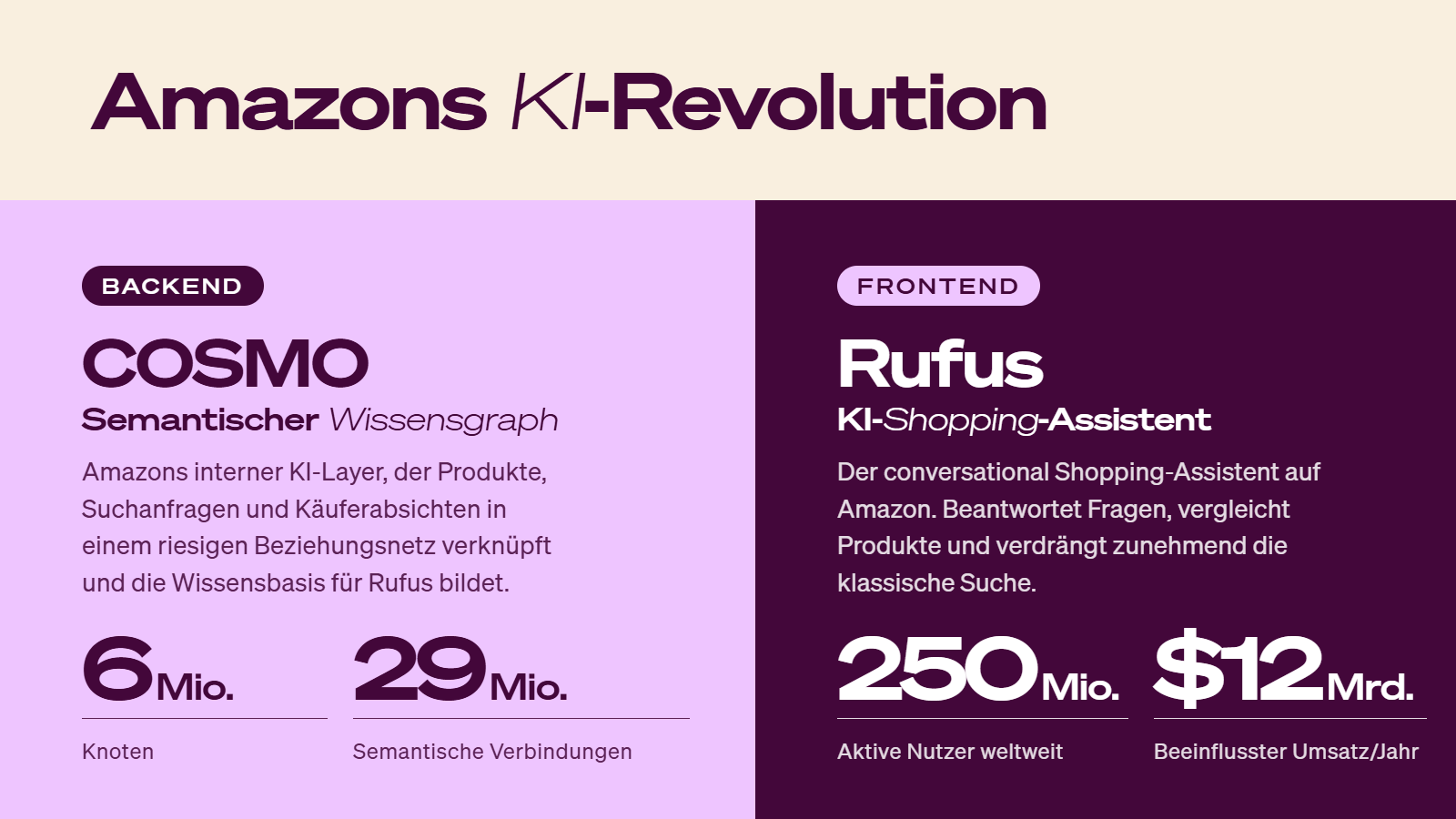
Rufus: Amazon’s AI shopping assistant with 250 million users
Rufus is Amazon’s AI shopping assistant, which has been rolling out worldwide since 2024. This generative AI assistant is available in both the Amazon app and the browser (still in beta in Germany as of February 2026) and fundamentally changes how customers discover products and make purchase decisions.
Instead of scrolling through classic search results, customers can now ask natural questions, for example: “Which blender is best for smoothies with frozen fruit?” They receive a personalized answer.
The special feature: Rufus does not just draw information from the listing text, but also from customer reviews, Q&A sections, and your product images. Rufus can read images (OCR) and extract information from infographics. Rufus is even supposed to consult external sources.

Subscribe to our newsletter and receive fresh updates every two weeks.
Amazon SEO Paradigm Shift: Why Keywords Are No Longer Enough
The fundamental difference can be summed up as follows
While the classic A10 algorithm mainly relied on keyword matching and accepted the seller’s text as truth, the new COSMO/Rufus system works very differently: It identifies the intent behind search queries, combines text, images, and reviews into an overall picture, and recommends products that solve problems—not those that simply contain the keywords.
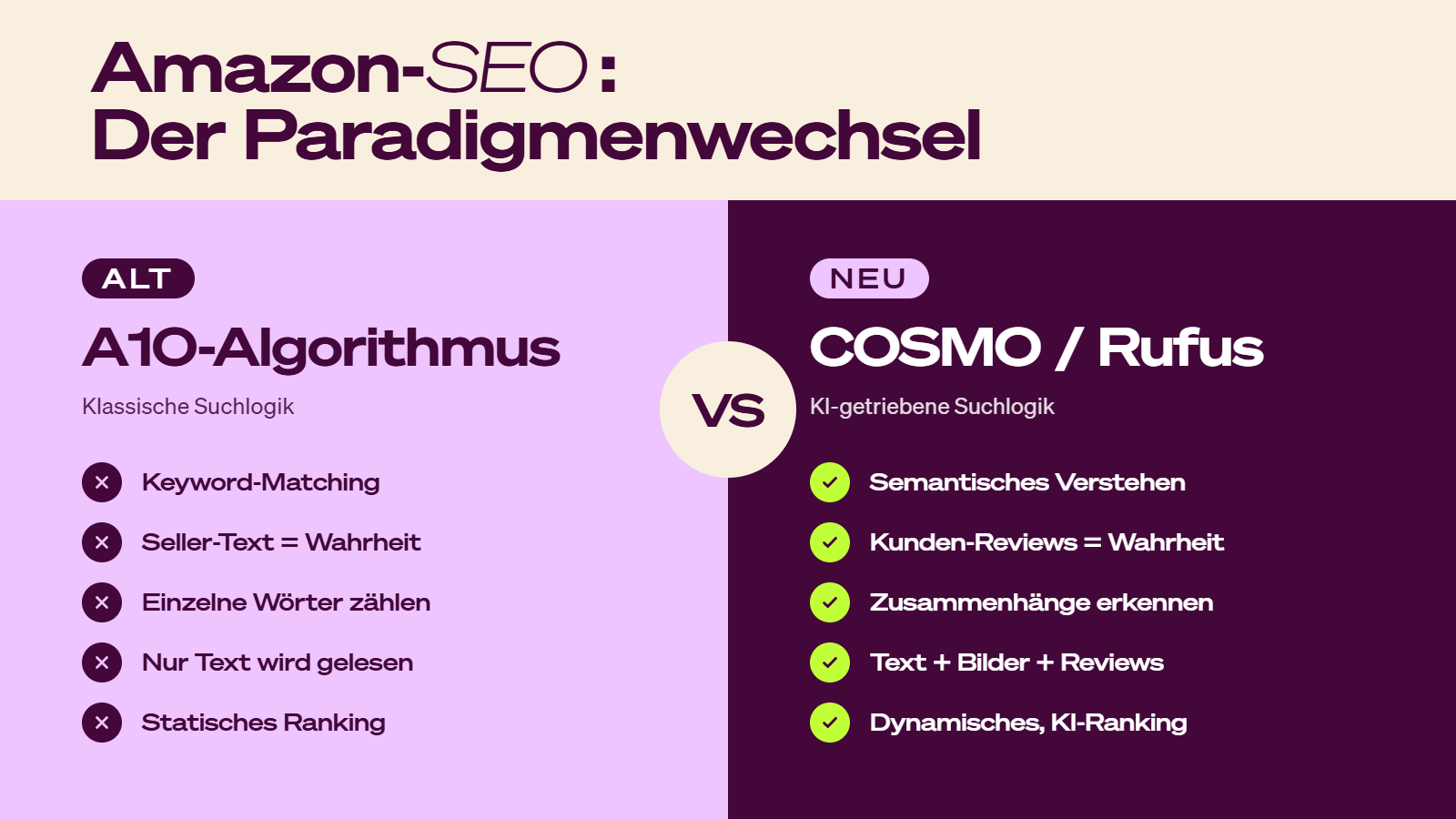
So: The especially critical point is “customer reviews = truth”: If 50 customers write in their reviews that your “beige” blanket actually looks “yellow,” COSMO will internally categorize the product as “yellow,” regardless of what the listing says. Customer perception overrides seller information.
COSMO in Practice: How Amazon’s AI Understands Customer Purchase Intent
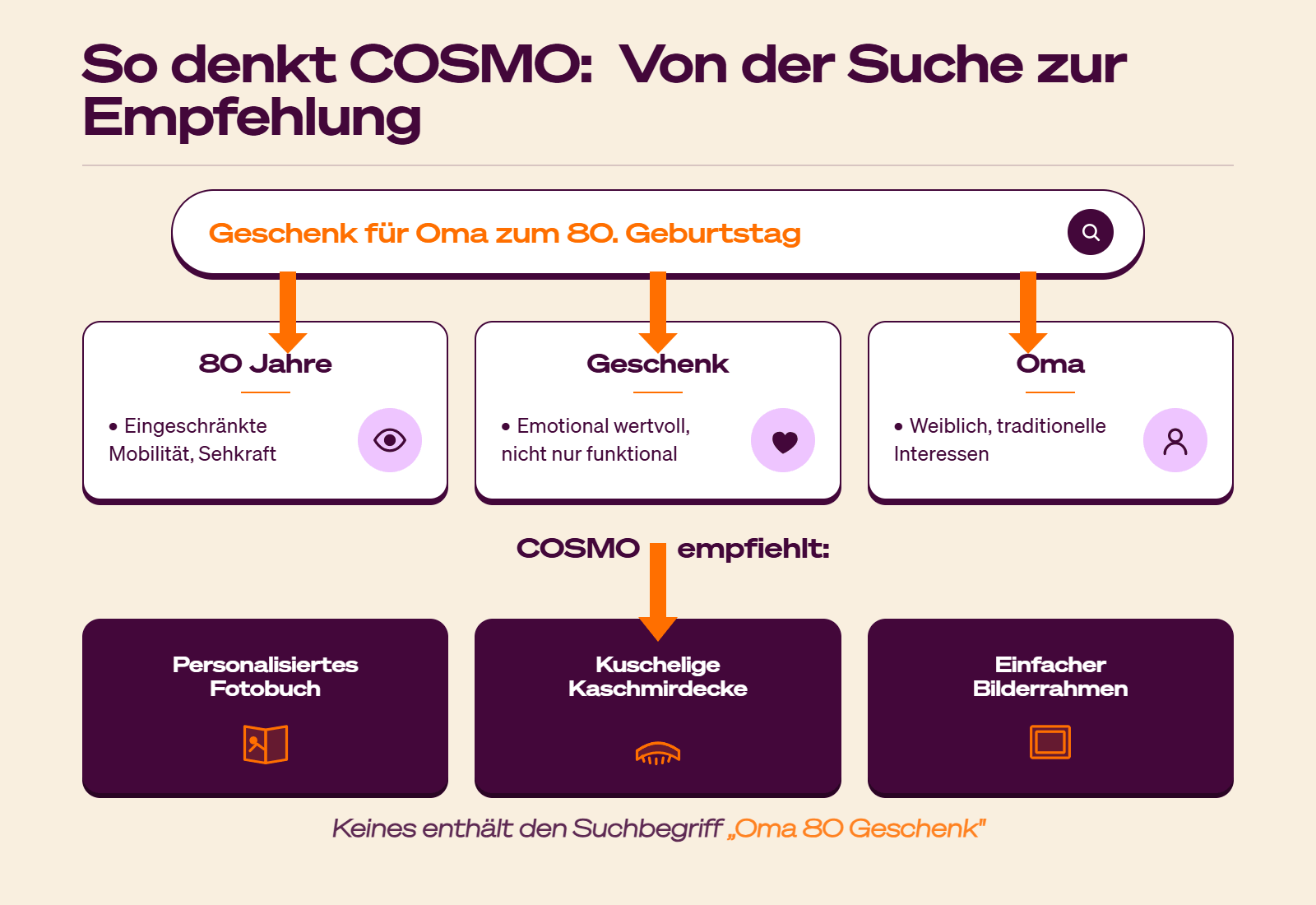
Let’s suppose a customer searches for “gift for grandma’s 80th birthday.” What happens?
Classic algorithm: Searches for products with the words “gift,” “grandma,” and “80” in the title or backend. Finds little of relevance, perhaps.
COSMO algorithm: Understands the context and connects:
80-year-old person = possibly limited mobility, eyesight
Gift = emotionally valuable, not just functional
Grandma = female, probably traditional interests
Result: COSMO recommends a personalized photo book with large print, a cozy cashmere blanket, or a digital photo frame that is easy to use. None of these products contains the search keyword “grandma 80 gift.”
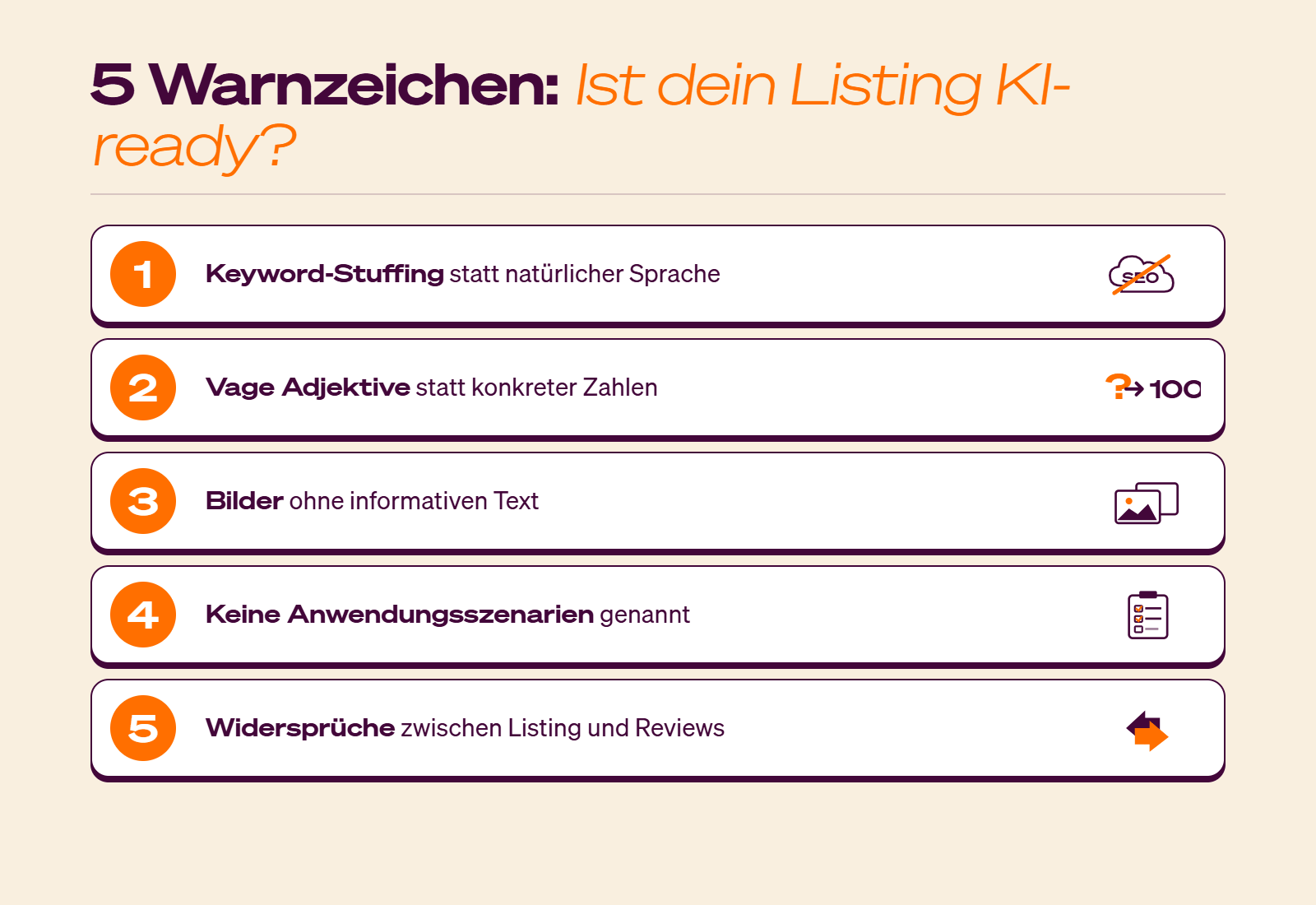
Five Warning Signs Your Listing Is Not Rufus-ready
Based on the analysis of hundreds of listings, we keep seeing the same patterns in products that are not recommended by Rufus:
1. Keyword stuffing instead of natural language
Listings like “Bluetooth headphones wireless headphones cordless in-ear sport jogging fitness” are hard for people to read and for Rufus to quote. Amazon AI, like AI in general, prefers content it can reproduce in natural language.
2. Vague adjectives instead of concrete numbers
“Super strong suction power” means nothing to Rufus. “2,500 Pa suction power,” on the other hand, is information the AI can process and compare. Specificity beats marketing language.
3. Images without informative text
Rufus reads your infographics via OCR. If it only says “premium quality,” the AI learns nothing. If it says “5-year warranty | 100% BPA-free | 500ml capacity,” Rufus has usable data.
4. No usage scenarios mentioned
COSMO evaluates products based on relations like “used for,” “used by,” “used in.” If your listing doesn’t clarify which situations, target groups, and locations your product is intended for, the AI misses important connections.
5. Contradictions between listing and reviews
If you promise “quiet” but 20 reviews mention “loud,” Rufus will trust customer perception. The AI considers reviews as “ground truth” and the more reliable source of information.
Amazon Listing Strategy 2026: Three Mindsets for Rufus Visibility
The good news: switching to Rufus or COSMO-optimized listings is not a complete restart. Many best practices remain valid — they just need to be expanded. Three mindsets that will be crucial in 2026:
1. Listings as a knowledge base
Every bullet point, every image, every answered question feeds the knowledge graph. Completeness beats brevity.
2. Consistency across all touchpoints
Text, images, A+ content, reviews, and Q&A all need to tell the same story. Contradictions confuse the AI.
3. Review management as listing maintenance
What customers write directly influences how COSMO categorizes the product. Proactive review management is no longer just a nice-to-have.
Rufus Test: How to Check Your Product’s AI Visibility
There’s a simple test to check the AI visibility of your products:
Open the Amazon app and enable Rufus (the Rufus icon at the bottom right).
Ask a typical customer question about your product category, e.g., “Which immersion blender is best for baby food?”
Then check whether your product is listed in the recommendations.
Ask on your product page: “What are the pros and cons of this product?”
Check if Rufus correctly summarizes your selling points.
If Rufus does not mention your product or provides incorrect information, it’s a clear sign: your listing still isn’t optimized for the new AI world.

Conclusion: The time for Rufus-optimized listings is
The shift from keyword-based to semantic search is not just futuristic talk—it’s happening right now. Brands that quickly understand how COSMO and Rufus work will gain a competitive advantage that classic SEO optimization can no longer catch up to.
The key question is no longer: “Am I ranking for my keywords?” but rather: “Does Amazon’s AI understand why my product is the best solution for my customers’ problem?”
Frequently Asked Questions (FAQ)
What is Amazon COSMO and how does the knowledge graph work?
Amazon COSMO (Common Sense Knowledge Generation) is an AI system that uses a knowledge graph with over 6 million nodes and 29 million connections. It semantically links products, features, and customer needs, allowing Amazon to understand the intent behind search queries—not just individual keywords.
How does Rufus impact the visibility of my Amazon listing?
Rufus is Amazon’s AI shopping assistant with over 250 million users. It answers natural customer questions and pulls information from your listing text, images via OCR, reviews, and Q&A sections. If your listing doesn’t provide enough usable information, Rufus will recommend the competition, making your offer invisible to this still small but steadily growing segment of search queries.
What should I keep in mind when optimizing my Amazon offer in the age of AI?
The most important shift: from keyword stuffing to natural, semantic language. Your listing needs to deliver specific use cases, detailed product data, and consistent information across all touchpoints. Images with readable text are especially valuable because Rufus extracts information from them using OCR.
Why are customer reviews so important for COSMO and Rufus?
COSMO and Rufus consider customer reviews as “ground truth”—a more reliable source of information than the seller text. If 50 customers say that your “beige” blanket actually looks “yellow,” COSMO will categorize the product as “yellow.” Proactive review management will therefore be indispensable in 2026.
How can I test whether my listing is AI-ready?
Open Rufus in the Amazon app, ask typical customer questions for your product category, and check whether your product is recommended. Alternatively, you can request the Boost^AI Score from Valuezon, which evaluates your listing based on 25 COSMO and Rufus relations and provides concrete recommendations for action.