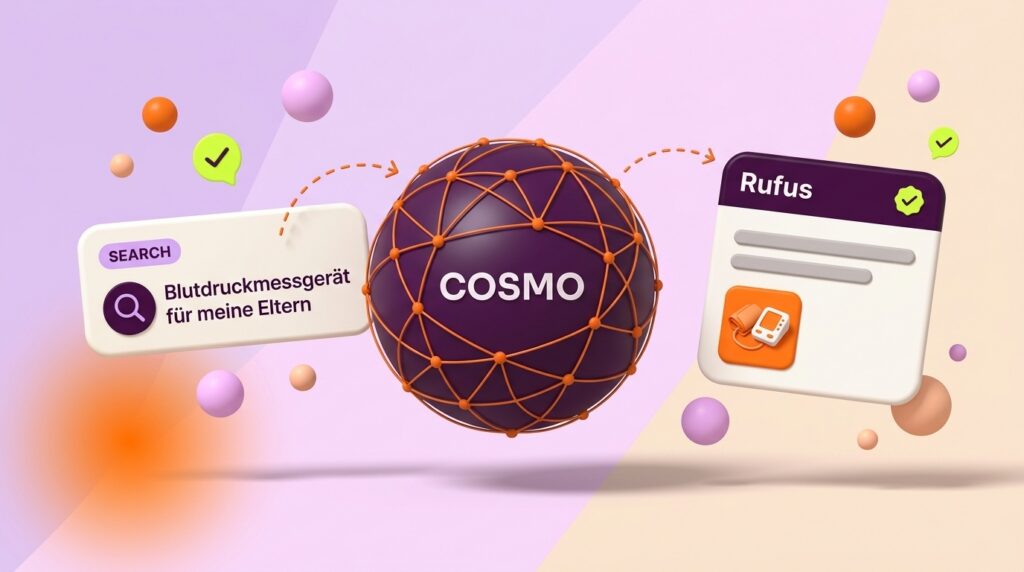
Amazon no longer treats products as text documents with keywords, but as nodes in a semantic knowledge network. COSMO, the underlying system, is noticeably changing the rules of the game for listing optimization. In this article, you’ll learn how the knowledge graph is structured, which 15 relations it recognizes, and what that means concretely for your listing.
From Keyword Index to Knowledge Graph: What COSMO Does Differently

Those who cover relations in the COSMO knowledge graph are prioritized in rankings and AI recommendations. Keyword optimization alone is no longer enough.
- COSMO replaces text-based keyword matching with semantic relations
- Each product is modeled as a node with typed connections to target audiences, occasions, and contexts
- Familiar parallel: Google Knowledge Graph, but for e-commerce
- Those who cover relations in the knowledge graph are prioritized in rankings and AI recommendations (Rufus, since May 2026 known as “Alexa for Shopping”)
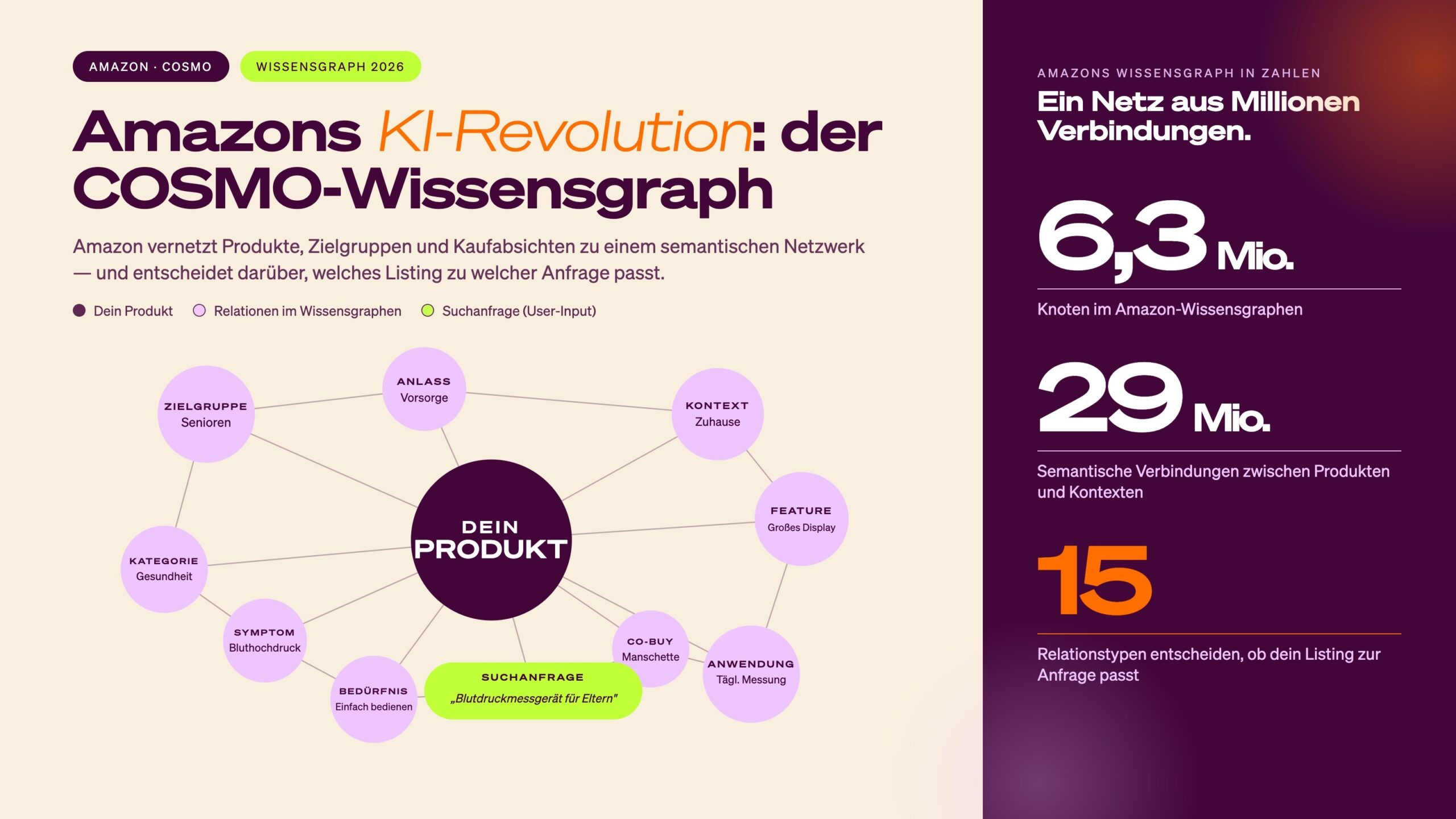
Amazon’s product search previously worked, simply put, like an index: enter keyword, get product with keyword. COSMO replaces this approach and relies on a knowledge graph. In it, each product is linked to target audiences, use cases, and purchase contexts through typed relations.
So Amazon no longer connects search queries with offer texts, but rather the presumed purchase intentions behind those queries with the holistic product knowledge Amazon has collected about product offerings on its platform.
For your listing this means quite practically: Keyword optimization alone is no longer enough. COSMO evaluates whether your product has the right connections in the knowledge graph—to which target audiences, for which occasions, in what usage contexts. If these connections are missing, so is your visibility!
Note: The technical details about COSMO are based on the Amazon Science Paper “COSMO: A large-scale e-commerce common sense knowledge generation and serving system” (SIGMOD 2024). The 15 relations defined there (Table 2 of the paper) form the basis of this article.
Update May 2026: Amazon has officially grouped its AI shopping assistant Rufus under the name “Alexa for Shopping” (Source: aboutamazon.com, May 13, 2026). The underlying technology remains the same; only the brand name on the interface is changing. In this article, we continue to refer to Rufus, since all mechanisms relate to it. Wherever Rufus is mentioned, this now also applies to Alexa for Shopping.
Subscribe to our newsletter and receive fresh updates every two weeks.
The Architecture of Amazon COSMO: 6.3 Million Nodes at Work
6.3 million nodes, 29 million connections, 18 product categories. These are the key data points of Amazon’s knowledge graph. And it’s still growing: COSMO continuously learns from customer behavior and reviews. In a test run with 10% of US traffic, the system achieved a relative revenue increase of 0.7%, which, at Amazon’s scale, is worth several hundred million dollars annually.
How COSMO Learns from Customer Data
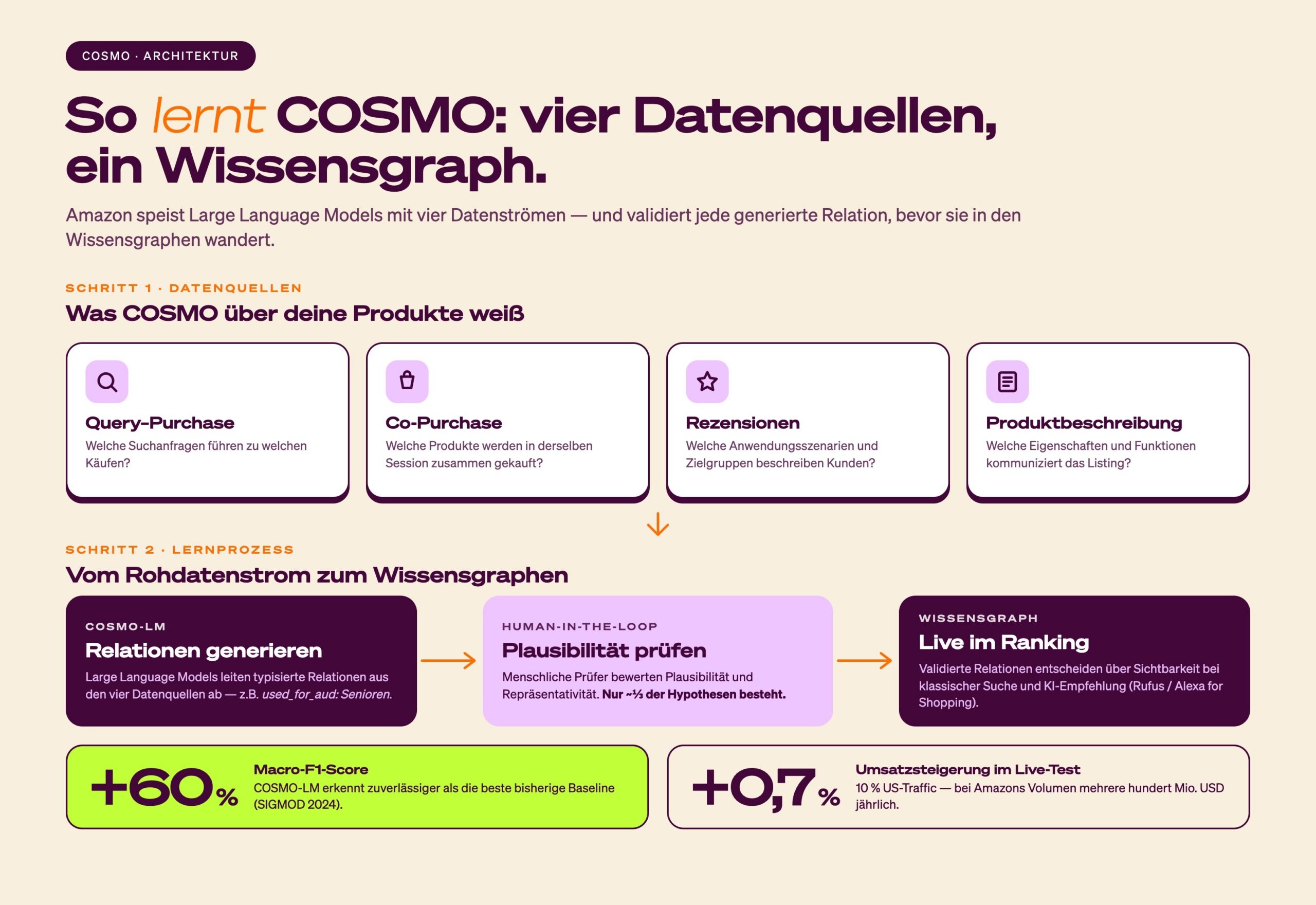
COSMO uses Large Language Models to extract structured product knowledge from four data sources:
- Query-purchase pairs: Which searches lead to which purchases?
- Co-purchase pairs: Which products are bought together in the same session?
- Review content: Which use cases, target audiences, and contexts do customers describe?
- Product descriptions: Which features and functions does the listing communicate?
From this data, COSMO generates typed relations. Example: If numerous customers search for “blood pressure monitor for seniors” and then buy a device with a large display and one-button operation, the system learns several relations: used_for_aud: seniors, capable_of: easy operation and used_in_loc: at home. These relations become part of the knowledge graph and influence future search results.
The quality of this automatic knowledge recognition can be quantified: In the SIGMOD study, COSMO-LM achieved a Macro-F1 score that was 60% higher than the best previous baseline. The Macro-F1 score is a standard metric in information science. It measures how reliably a model identifies relationships and how few errors it makes in doing so. An increase of 60% means: COSMO-LM is significantly more reliable at identifying which relationships between products and purchase situations are typical and robust, and filters out random correlations.
Amazon relies on a “human-in-the-loop” process for this: Human reviewers evaluate automatically generated relations for plausibility and representativeness. Only around one third of the generated hypotheses pass this review (SIGMOD 2024). For the knowledge graph, this means higher data quality for the relations that determine the presentation of your product.
All 15 COSMO Relations in Detail Using the Example of a Blood Pressure Monitor
- COSMO evaluates products based on 15 defined relation types
- Each relation describes a different aspect of product knowledge
- Missing relations mean gaps in the knowledge graph and fewer impressions
To make the 15 relations tangible, we follow them using a consistent example: an upper arm blood pressure monitor. In this way, each relation demonstrates what COSMO specifically expects in the knowledge graph and what should be included in your listing.

Function and Product: What it Can Do and What it Is
These six relations define the core purpose, capabilities, and classification of your product:
used_for_func: the core function for which the product is primarily used. For the blood pressure monitor: measuring blood pressure and pulse. This relation may sound trivial, but is often not communicated explicitly enough: for example, when a listing only says “health monitor” instead of “measures systolic and diastolic blood pressure as well as pulse”.capable_of: specific capabilities and features that distinguish the product. For the blood pressure monitor: arrhythmia detection, averaging values from three measurements, memory for two users. Exactly these concrete capabilities determine whether COSMO can match your product to specific searches like “blood pressure monitor with heart rhythm detection”.used_to: the problem the product solves. For the blood pressure monitor: monitoring high blood pressure, documenting readings for doctor visits. Especially for intent-based search queries like “checking blood pressure at home”, this relation is key.is_a: the category assignment. How does COSMO classify your product taxonomically? For the blood pressure monitor: medical device, health electronics, upper arm blood pressure monitor. The more precise the classification, the more targeted the presentation.used_as: the role of the product. Is it used as a spare part, gift, or upgrade? For the blood pressure monitor: supplement to doctor visits, entry into self-monitoring, gift for parents. If reviews frequently mention “bought as a gift for my mother”, COSMO learns this role.used_with: complementary products that are typically used together. For the blood pressure monitor: XL cuffs for larger upper arms, power adapters, carrying cases, blood pressure logbooks. COSMO learns these relationships from co-purchase data. When customers regularly buy replacement cuffs with the monitor, it strengthens this relation.
Target Group and Motivation: Who It Is For
These five relations describe who needs the product, who buys it, and why:
used_for_aud: the defined target group. For the blood pressure monitor: people with hypertension, seniors, pregnant women with increased blood pressure risk. This relation answers the question: For whom was the product explicitly developed?used_by: who buys and uses the product in everyday life. Often derived from review data. For the blood pressure monitor: patients themselves, caring relatives, health-conscious adults over 40. The difference toused_for_aud: That shows who it is intended for. This shows who actually uses it in practice – sometimes a completely different group.x_interested_in: interests and affinities of the target group that go beyond the product itself. For the blood pressure monitor: preventive healthcare, fitness tracking, telemedicine. This relation helps COSMO respond to queries like “home health products”, even if the word “blood pressure monitor” doesn’t appear.x_is_a: characteristics of the target group. For the blood pressure monitor: health conscious, preventive-oriented, possibly chronically ill. COSMO uses this meta-information to build target group clusters and link products across categories.x_want: what the target group wants to achieve, overarching goals and needs. For the blood pressure monitor: monitoring your own health, preparing for doctor visits, controlling medication effects. This relation is particularly valuable for search queries that state a goal instead of naming a product.
Context and Situation: When and Where It Is Used
These four relations describe the circumstances under which your product is needed:
used_in_loc: the place of use. For the blood pressure monitor: at home, on the go (travel blood pressure monitor), in a medical practice. A listing that mentions “compact and lightweight for on the go” actively serves this relation.used_for_eve: the occasion or activity. For the blood pressure monitor: routine measurement in the morning and evening, monitoring before a doctor’s visit, tracking after a change in medication. If your listing mentions such occasions, COSMO can display your product for situation-based queries.used_on: the surface or material on which the product is used. This relation is more relevant for products like paints (on wood), creams (on skin), or tools (on metal). For the blood pressure monitor it is less central. Not all 15 relations are equally relevant for every product. COSMO automatically weights which relations are typical for a product category.used_in_body: the body location, especially relevant for cosmetics, medical devices, and wearables. For the blood pressure monitor: upper arm or wrist. This information is crucial for differentiation: “Upper arm blood pressure monitor” and “wrist blood pressure monitor” are two different product types for COSMO.
Practical Example: How COSMO Resolves a Natural Language Search Query
A concrete case example makes the mechanism more tangible. Let’s take the search query: “Blood pressure monitor for my parents, easy to use.” You can replicate this search on Amazon.de. The results show how COSMO works.
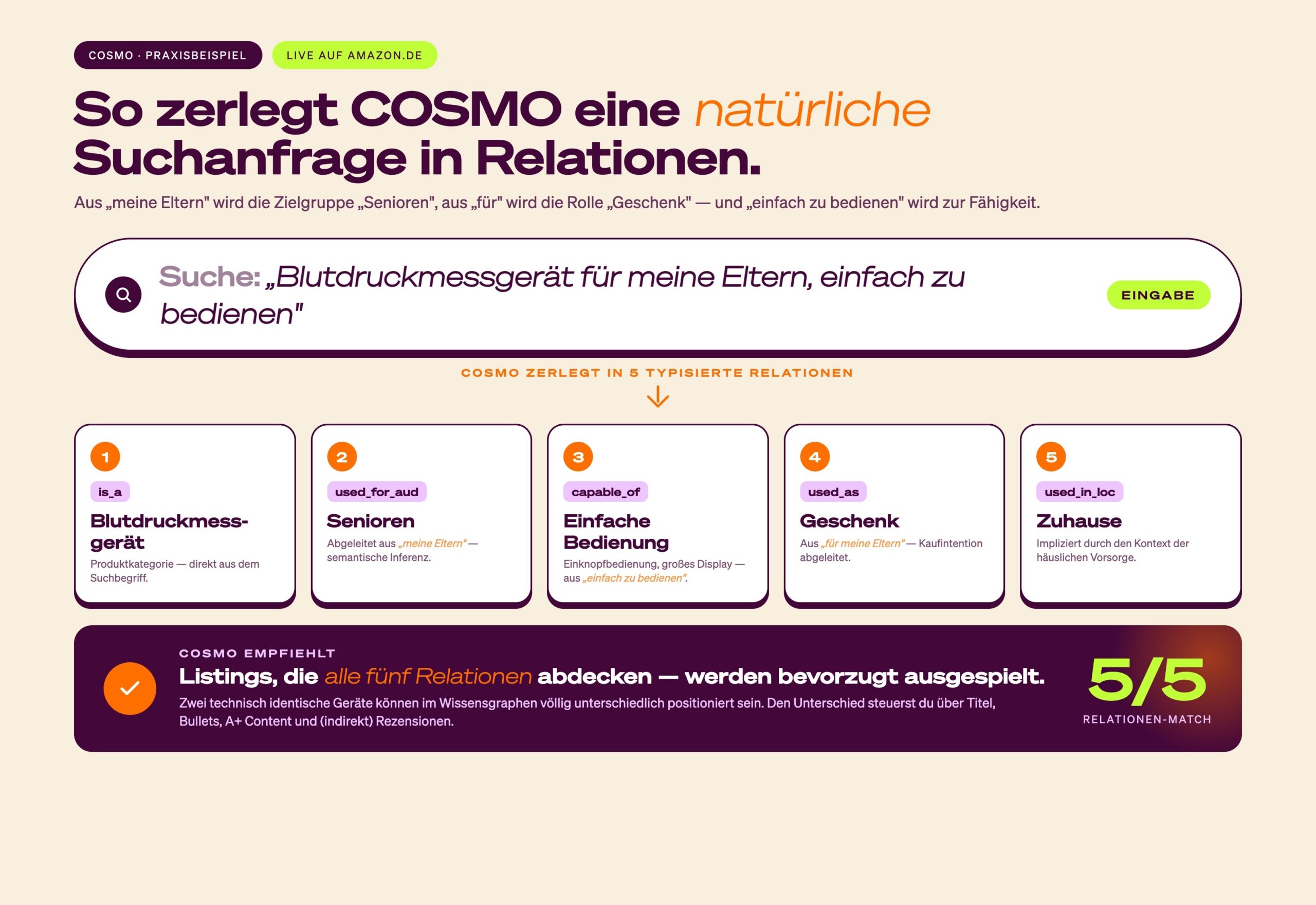
COSMO breaks down this query into several relations:
is_a:Blood pressure monitorused_for_aud:Seniors (derived from “my parents”)capable_of:Easy to use (one-button operation, large display)used_as:Gift (derived from “for my parents”)used_in_loc:At home (implied by context)
The system matches these relations against the knowledge graph. An upper arm blood pressure monitor with one-button operation, a large display, and arrhythmia detection, which is often mentioned in reviews as “bought for my mother” or “super easy for seniors,” covers all five relations. It is preferred over a technically identical product without this contextual information.
The result sounds trivial, but it’s not: Two blood pressure monitors with identical measuring functions can be positioned completely differently in COSMO’s knowledge graph. The difference is not in the product itself, but in the quality of the available relations. And you control those through your listing, your A+ content, and (indirectly) your reviews.
Incidentally, in the classic search results, it’s not clear why the devices are easy for your parents to use. In the Rufus chat (now Alexa for Shopping), the result is much more explicit: two products are shown for each of three clearly named requirements:
- Easiest operation (one-button operation)
- Large displays & comfort
- Trusted brands with high rating
Rufus also provides accompanying text: “All devices have cuffs for 22–42 cm arm circumference, detect heart rhythm disturbances, and are clinically validated. The Beurer and Braun models are especially user-friendly. Which features are most important for your parents: large numbers, easy operation, or app connectivity?”
Limits of COSMO: Where the System Is Tied to Its Data
COSMO is data-driven and thus bound to the available data points. If your listing does not contain information about usage scenarios and the reviews give no clues, the corresponding relation in the knowledge graph remains empty. Empty means: invisible to search queries that address this very relation.
New product categories are correspondingly underrepresented in the knowledge graph. Niche products with little purchasing data have a harder time because COSMO has fewer signals available.
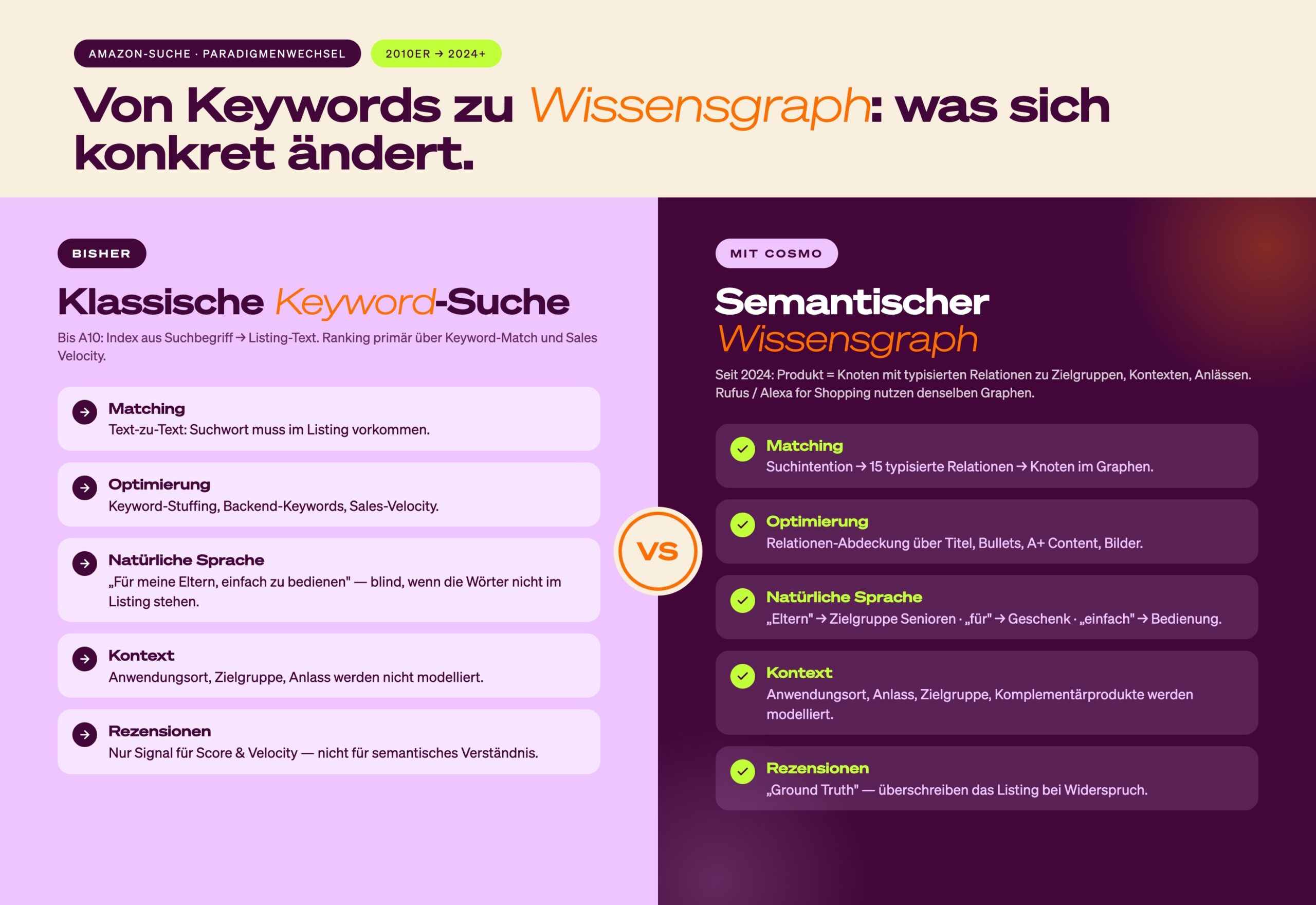
A point that many overlook: When listing information and customer perception diverge, COSMO always prioritizes the customer view. Reviews are considered the “ground truth.” If you write “for professionals” in your listing, but reviews repeatedly say “good for beginners,” COSMO will assign your product to the beginner target group. No matter what you communicate.
Three Weaknesses That Cost Visibility
- Empty relations: Your listing doesn’t address certain relations at all. For example, if you don’t describe usage scenarios and your product reviews don’t provide any clues in this regard either, COSMO can’t form any context relations, and your offer is invisible in context-driven searches.
- Contradictory signals: Your product offer and the associated customer reviews tell different stories. COSMO follows the reviews and perceives the contradiction, i.e., your positioning is undermined.
- Missing context dimensions: Your listing is well-positioned for the core functions but doesn’t cover other relevant dimensions. This doesn’t mean you should try to be “everything for everyone.” On the contrary: Stay clear in your positioning, but also communicate the contexts that match your target group. A blood pressure monitor for seniors shouldn’t just describe the measuring function but also name the place of use (at home), the occasion (routine measurement in the morning and evening), and complementary products (XL cuff, storage bag). Each missing dimension is a missed opportunity for coverage in relevant search queries.
Five Points of Action for Your Listing: COSMO Optimization in Practice
- Each of the 15 relations is a point of action that you can actively manage in your listing
- A+ Content offers the greatest flexibility for shaping context and audience relations. An analysis of over 1,300 Rufus-recommended products shows: 87% of them have A+ or A+ Premium Content (Amalytix, 2026)
- Reviews determine what COSMO considers to be “truth”
- Consistency across all touchpoints is essential
You can actively control how COSMO positions your product in the knowledge graph. These five levers have the greatest impact:
- Systematic relations check: Go through each of the 15 relations and check: Does COSMO find this information in your listing, whether in the title, bullet points, description, or A+ Content?
- A+ Content as a relations driver: Infographics, comparison tables, and use cases, which often only have space in A+ Content, feed the context and audience relations.
- Review monitoring with a relations perspective: Take a look at which relations your customers address in their reviews. Does that align with your listing strategy? Where are there gaps or contradictions? How might you need to adjust the product or its positioning to ensure consistency between expectations and performance?
- Consistency across all touchpoints: Title, bullet points, description, A+ Content, and backend keywords must all tell the same story. If the signals contradict each other, your product’s profile in the knowledge graph becomes diluted.
- Visual carriers of information: Lifestyle images and infographics convey relations that text alone cannot. Usage contexts, target audience signals, places of use: all of this works even without a bullet point. For our blood pressure monitor: An image showing an older person measuring their blood pressure at the breakfast table simultaneously covers
used_for_aud,used_in_locandused_for_eve.
In the next article, we’ll show how Amazon’s AI assistant Rufus (now officially “Alexa for Shopping”) leverages COSMO data and which additional factors play a role in the conversational AI recommendation.
Free AI-Readiness Analysis: How does your listing stand in the COSMO knowledge graph? With the Boost^AI Score, you get a detailed analysis based on 25 COSMO and Rufus factors, including prioritized action recommendations. Request it now for one ASIN free of charge.
Frequently Asked Questions about Amazon COSMO (FAQ)
What is Amazon COSMO and what role does it play for product search?
Amazon COSMO (Common Sense Knowledge Generation and Serving System) creates a knowledge graph with 6.3 million nodes and 29 million connections. The system extracts structured product knowledge from customer data and listing content via large language models, and validates the results for plausibility and representativeness through human reviewers. In a test with 10% of US traffic, COSMO achieved a 0.7% relative sales lift. At Amazon volumes, this equates to several hundred million dollars annually.
How does COSMO differ from the A10 algorithm?
A10 ranks products primarily through keyword matching and sales velocity. COSMO operates at a different level: it models semantic relationships between products, target audiences, and purchase contexts. A search query like “blood pressure monitor for my parents, easy to use” is not matched as a keyword string, but broken down into typed relations and checked against the knowledge graph.
What impact do the 15 COSMO relations have on listing visibility?
Each relation is a potential matching point between a search query and a product. Listings that cover more relevant relations are displayed more often for natural language search queries and AI recommendations (Rufus). Missing relations mean: For certain search queries, your product does not exist in the knowledge graph.
What is the most effective approach to COSMO optimization?
A+ Content offers the greatest flexibility: use cases, audience visualizations, and context information directly feed the COSMO relations. An analysis of over 1,300 Rufus-recommended products shows that 87% have A+ or A+ Premium Content (Amalytix, 2026). In addition, consistency between listing content and customer reviews is important. COSMO treats reviews as a primary data source and prioritizes them in case of discrepancies.
How are Amazon COSMO and Rufus connected?
COSMO provides the structured knowledge graph, Rufus uses it for conversational product recommendations. Since May 2026, Rufus appears on the Amazon interface under the name “Alexa for Shopping.” The underlying technology remains the same, only the brand name on the interface changes. Over 250 million customers have used Rufus, and customers who use Rufus are 60% more likely to buy. If you optimize for COSMO, you also improve your chances of being recommended by Rufus (and thus Alexa for Shopping).
Sources
- COSMO: A large-scale e-commerce common sense knowledge generation and serving system at Amazon – Amazon Science
- COSMO: A Large-Scale E-commerce Common Sense Knowledge Generation and Serving System at Amazon – Yu et al., ACM SIGMOD 2024
- Building commonsense knowledge graphs to aid product recommendation – Amazon Science Blog
- Amazon Rufus Study: 1,300+ Products Reveal AI Recommendation Patterns – Amalytix, 2024
- Amazon’s latest AI Algorithm COSMO, and what it means for Amazon Search – Ecomtent
- COSMO: Amazon’s AI-Driven Search Algorithm – VML
- Amazon Rufus – AI Shopping Assistant – About Amazon
- Meet Alexa for Shopping, your personalized, agentic AI assistant on Amazon – About Amazon (May 13, 2026)