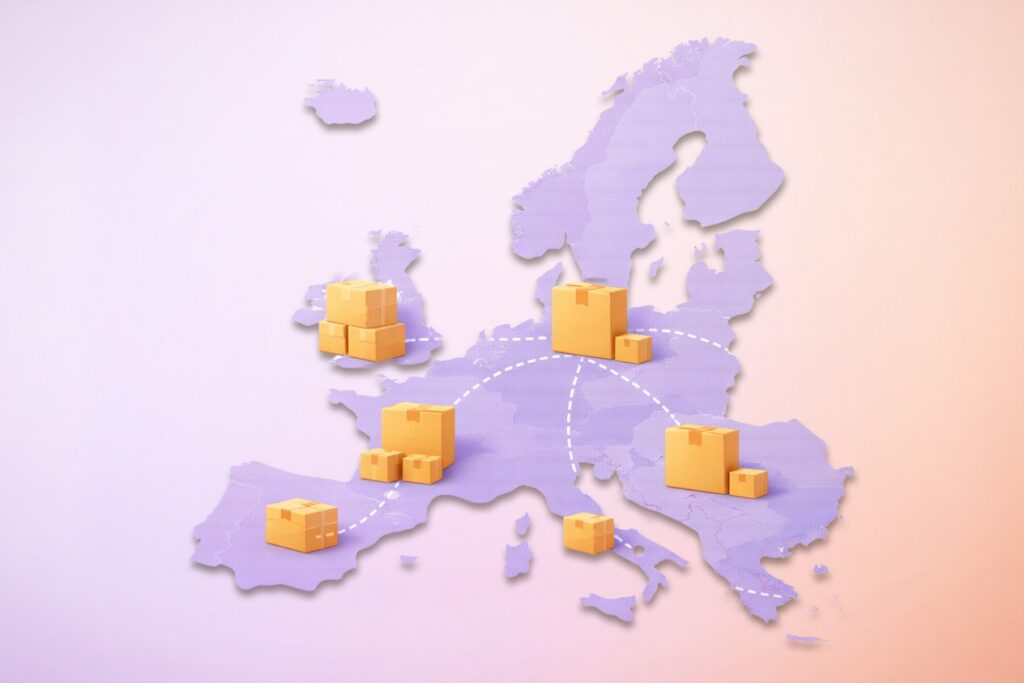
Amazon offers sellers in Europe three programs to store and sell products internationally: the Central Europe Program, the European Fulfilment Network (EFN), and the Pan-EU program. Each model provides its own opportunities—from lower FBA fees to Europe-wide Prime shipping.
In this article, we’ll show you how the programs work, where your goods are stored in each case, and which aspects you should keep an eye on in practice.
Central Europe Program
Note: This article does not replace professional tax advice. If you have questions regarding tax obligations, please consult your tax advisor.

Central Europe, EFN, or Pan-EU: Choosing the right Amazon program affects your FBA fees, delivery times, and tax obligations—and thus has a direct impact on your competitiveness in the European market.
The Central Europe Program concerns only the storage location of your goods. The aim of this program is not to expand sales to other European countries, but to lower FBA fees for products sold on the German marketplace. By participating, you authorize Amazon to store your inventory not only in Germany but also in Poland and the Czech Republic. This reduces the FBA fee for all products by €0.26 per unit, which can lead to noticeable savings for larger sales volumes.
However, storing goods in Poland and the Czech Republic comes with additional tax requirements. You must register for tax purposes in both countries and submit VAT returns there regularly.
Summary
Advantages: Reduction of FBA fees by €0.26 per unit for all products sold on the German marketplace.
Disadvantages: Tax registration and regular submission of VAT returns in Poland and the Czech Republic are required.

Subscribe to our newsletter and receive fresh updates every two weeks.
European Fulfilment Network (EFN)
EFN offers one of the simplest ways to sell abroad. Your products are stored exclusively in German warehouses. From there, Amazon can ship to other European countries as needed — such as Italy, Spain, or France.
To make your products visible on other European marketplaces, it is theoretically sufficient to activate “International Listing Creation.” Amazon will then automatically transfer your German listing to the respective countries in the local language. However, in practice, automatic translations are often not of high quality. Therefore, we generally recommend a professional translation, independent keyword optimization, and country-specific images to maximize your performance in each market.
Using EFN comes with higher shipping costs compared to local shipping. The exact fees can be found in Amazon’s current FBA Rate Card. Therefore, adjust your selling prices on foreign marketplaces to cover the additional costs. Depending on your sales volume, participation in the OSS (One-Stop Shop) scheme may also be required.
In addition to organizational aspects, you should ensure that your products in the respective destination countries comply with legal requirements. These include, among others, safety and labeling obligations as well as any necessary certifications.
Summary
Advantages: Selling across Europe is possible without needing to store goods abroad. As a result, tax registration in other countries is generally not necessary.
Disadvantages: No Prime shipping due to long delivery times, as shipping is always from Germany, and higher shipping costs compared to local shipping.
Pan-EU Program
To participate in the Pan-EU program, you must list your products on the local marketplaces in Germany, France, Italy, Spain, and the Netherlands. You can also use “International Listing Creation” for this purpose.
You also authorize Amazon to store your goods in at least two of the above-named countries. By storing locally, you benefit from local FBA fees, which are cheaper than shipping via EFN. In addition, delivery times are shorter due to local shipping.
Cost Comparison: EFN vs. Pan-EU Shipping
In practice, it is advisable to register for tax in all countries and to allow Amazon to store goods in all countries (Germany, France, Italy, Spain). Otherwise, when shipping to countries not activated for storage, the higher EFN fees will apply again—with the exception of the Netherlands, where you can benefit from lower shipping costs even without tax registration.
Amazon automatically takes care of transport to the various European warehouse locations. You only need to send your products to German Amazon warehouses—the subsequent distribution within Europe is handled centrally through Amazon’s logistics network. This eliminates additional shipping costs and administrative effort, making cross-border sales significantly more cost-efficient.
However, these advantages are also associated with additional obligations. For every country in which Amazon stores your goods, you are required to register for tax purposes. Regular VAT returns must also be submitted there. With this program as well, you should familiarize yourself with the OSS procedure.
In addition to meeting tax requirements, you should also ensure that your products comply with the respective legal regulations in all target countries. This includes, in particular, product safety requirements, labeling obligations, and any necessary certifications.
Summary
Advantages: Your products can be offered throughout Europe and shipped at local FBA fees. Amazon handles cross-border logistics, so you only need to ship to German warehouses. Lower fees and shorter delivery times, compared to EFN, result in higher competitiveness.
Disadvantages: Tax registrations and the regular filing of VAT returns are required in all storage countries. In addition, a low-inventory fee is charged when the average stock coverage is below 28 days. This additional fee applies in Germany, France, Italy, and Spain, and is calculated weekly based on historical inventory levels.
Conclusion
Whether it’s the Central Europe Program, EFN, or Pan-EU – each model offers its own opportunities and challenges. While the Central Europe Program focuses on cost savings through lower FBA fees, EFN provides the easiest entry into Europe-wide sales. Pan-EU, on the other hand, offers the greatest sales potential and the best shipping conditions, but requires the most comprehensive tax obligations.
Which option is right depends heavily on your individual situation: sales volume, target markets, and internal resources play a decisive role. It’s important to carefully weigh the pros and cons of each program and keep both logistical and tax aspects in mind.
You want to expand your Amazon business across Europe but are unsure which program suits you best? Our Amazon agency, headquartered in Munich, supports you in choosing the right strategy and accompanies you in expanding into international markets. Get in touch now – we can help you!