If you sell on Amazon, since Rufus you are no longer dealing with just one search, but two. We submitted four search queries twice, once in the classic results list and once in the AI assistant Rufus, and saw four completely different top results each time. Here you’ll learn why your listing needs to be built for both channels if you want to stay visible in 2026.
Methodology in 90 Seconds

Rufus and the classic Amazon search often answer the same question with completely different products. That’s why you need two perspectives for each listing, not just one.

Fig. 1: The Pair Principle. A control query plus an intent query, both on SERP and Rufus, followed by standardized evaluation. Source: Valuezon, own survey 2026.
For each pair, we formulated two queries. The control query is a broad designation like “mobile phone,” “sleeping bag,” or “birthday gift.” The intent query adds a strong condition, such as “for my 80-year-old grandma,” “for bikepacking,” or “for a 45-year-old father who likes to grill.”
Both queries go to Rufus and to the SERP on amazon.de. We compare the first organic results and answer the central question: Does the channel respond to the condition, or does it stick to the bestseller mix of the control query?
Three rules from previous sweeps form the basis of the test. You always start Rufus before the SERP because otherwise the chat carries over the search context and the answer gets contaminated. You open a new chat for each pair because Rufus can retain persona traces even after clicking “New Chat.” You exclude sponsored ads, otherwise you’ll be measuring ads instead of the algorithm.

Subscribe to our newsletter and get fresh updates every two weeks.
Case 1: Grill Gift – Where Rufus Excels and the SERP Falls Back on Clichés
Intent: “Birthday gift for a 45-year-old father who likes to grill”
Control: “Birthday gift for a 45-year-old”
This pair beautifully illustrates what Rufus can do and what the SERP cannot. Both receive the same query, but respond very differently.
What Rufus Delivers
Rufus recognizes the hobby right away and groups a clean cluster of “Professional Grill Accessories.” The Grilliance 27-piece plancha set takes the top spot, followed by a 38-piece professional set, then a stainless-steel grill tool set and the Ankerkraut grill set with six spices. In fifth place, there’s a premium organic BBQ spice set. Four out of four organic results directly relate to grilling, and Rufus adds a cross-sell toward spices. The request is fully understood.

Fig. 2: Rufus hit #1 for “birthday gift for a 45-year-old father who likes to grill.” Source: amazon.de, Valuezon survey 2026.
What the SERP Delivers
The organic SERP for the same query shows a completely different picture. In first place is not a grill, but a metal sign “45 Shield Birthday, 45 Classics.” In second place, an “mtb schnapps bench, 45 years, wood with engraving.” The SERP has understood the tokens “45” and “birthday,” but the “grilling” token only marginally. Only positions three and four show products truly related to grilling.

Fig. 3: Rufus hit #1 for “birthday gift for a 45-year-old father who likes to grill” Source: amazon.de, Valuezon survey 2026.
What This Means for Your Listing
If your grill accessory set is competing in the SERP, you need token density for “Father’s Day,” “birthday,” “45,” and “man,” because A9 evaluates each hit individually there. On Rufus, the hobby connection is much more important. Terms like “grill pro set,” “BBQ tools,” or “for hobby grillers” need to appear at the front of the title and in bullet 1. If you don’t separate the two, you’ll optimize correctly for one channel and miss the mark on the other.
Case 2: Grandma cell phone, both channels respond but at different depths
Intent: “Cell phone for my 80-year-old grandma”
Control: “Cell phone”
If you’re looking for a cell phone for your grandmother, you don’t want an iPhone 17 Pro Max. If the search understands this, the two queries look completely different.
Control Query “Cell phone”
In Rufus, the top tier of flagship smartphones appears. Samsung Galaxy S26 Ultra, iPhone 17 Pro Max, XIAOMI 17 Ultra, Google Pixel 10 Pro, plus a XIAOMI Redmi Note 15 Pro in fifth place. The SERP leans more toward the mid-range with the XIAOMI Poco C85, Samsung Galaxy A17 5G, and XIAOMI Redmi A5. Both channels hit the typical “cell phone” meaning in the consumer market with modern smartphones in the mainstream price range.
Intent Query “Cell phone for my 80-year-old grandma”
As soon as the secondary condition is added, the answer changes completely. Rufus delivers a pure seniors selection. Senior mobile GSM in first place, Emporia SIMPLICITY second, three artfone models in the remaining spots. All five hits are senior phones with large buttons and emergency call button. There is zero overlap with the control variant.

Fig. 4: Rufus for the intent variant with “grandma.” Pure senior cluster, zero overlap with control. Source: amazon.de, Valuezon survey 2026.
The SERP plays along surprisingly well. Positions one to five all show artfone models, each titled with “senior phone,” “emergency call button,” and “large buttons.” Again, zero overlap with control. A9 detected the word “grandma” as a senior trigger and filters for senior phones.
What this means for your listing
Unlike the grill case, the SERP here is semantically alert—probably because “grandma” appears explicitly in many listing titles and A9 picks it up as a token. As a small supplier of senior phones, you have a clear bestseller bias to overcome in the SERP, since artfone occupies the top spots. In Rufus, on the other hand, you have a chance of slipping into the semantic cluster if senior features like “emergency call button,” “photo direct dial,” and “large buttons” are prominent in the title.
Case 3: Bikepacking, Rufus filters for weight, SERP only for the word
Intent: “Sleeping bag for bikepacking”
Control: “Sleeping bag”
This is the purest use-case test. “Bikepacking” means light, small, compact—ideally under one kilogram. A normal winter sleeping bag with a comfort temperature of minus 18 degrees Celsius is completely out of place for this query.
What Rufus delivers
Six results, all ultralight. Trinordic 700g ultralight rectangular sleeping bag at number one, Trinordic 780g ultralight summer sleeping bag at number two, ALPENWERT summer with pack size 15 × 27 cm at three, MOUNTREX 760g for 10/20°C at four, NORDMUT 100 GSM at five, an AlpinSpirit ultralight model at six. All six have explicit weight or pack size in the title. No model weighs more than 900 grams.

Fig. 5: Rufus for “sleeping bag for bikepacking.” Weight and pack size explicit in the title, all results ultralight. Source: amazon.de, Valuezon survey 2026.
What the SERP delivers
The SERP has a different character. The top two spots are the same Trinordic models as in Rufus, but for a different reason. They have “bikepacking” in the title, and the SERP finds them through pure token matching. The fact that the Coleman Brazos (3.5 kg) appears in third and a Bessport winter mummy sleeping bag in fourth shows it clearly. The SERP doesn’t understand “bikepacking” semantically—it just looks for the word.
The contrast becomes clear in comparison. The control query “sleeping bag” yields exactly the heavy models in Rufus—Bessport minus 10 degrees and SkinWalker minus 18 degrees—that are missing in the bikepacking query. Rufus starts filtering for weight as soon as the secondary condition is added; the SERP does not.
What this means for your listing
For an outdoor brand with an ultralight sleeping bag, this query is gold if weight, pack size, and use-case (“bikepacking,” “trekking,” “ultralight”) are in the title and bullet 1. In the SERP, that’s enough because of token match; in Rufus, it’s because of semantic extraction. The reverse is also true. If you’re selling winter sleeping bags, you shouldn’t target the bikepacking query—it’s a different buyer group, and Rufus will filter you out, even if you try SEO tricks.
Case 4: Snoring partner, Rufus understands sender and receiver, SERP falls for the books
Intent: “Something that helps me sleep when my partner snores”
Control: “Anti-snoring aid”
This is the toughest query in the test and the one with the most dramatic outcome. Linguistically, the difference is subtle; semantically, it is fundamental. With “anti-snoring aid,” the snorer themselves is looking for a solution (sender). With the intent version, the partner of the snorer is seeking a solution for themselves (receiver). The world of products is completely different.
What Rufus delivers
For the intent version, Rufus delivers exactly the receiver world. Sleep headphones in first place (BT model), two different sleeping earplugs in second and third, a Momcozy white noise machine with nightlight in fourth, a Dreamegg D11Max white noise machine in fifth. All five results protect the receiver, that is, the partner of the snorer. The control “anti-snoring aid” delivers the exact opposite: nasal strips, magnetic nasal clips, and chin straps— all sender solutions. The overlap between intent and control in Rufus is zero.

Fig. 6: Rufus for the intent version. Protection for the partner, not the snorer. Source: amazon.de, Valuezon survey 2026.
What the SERP delivers
Now, the kicker. The SERP for “Something that helps me sleep when my partner snores” delivers five books in the top five spots. “Sleep Problems” in first place. “Sleeping Crying” in fourth. “Sleep Elixir” in fifth. “Baby Sleeps!” in sixth. Once again “Sleeping Crying v2” in seventh.

Fig. 7: SERP position 1 for the intent query. The Books Bug kicks in with verb constructions using ‘sleep’ and ‘help’. Source: amazon.de, Valuezon survey 2026.
This is the so-called Books Bug. The A9 parser interprets verb constructions with “sleep” and “help” as a book title signal and shifts the query to the books index, completely missing the actual problem. We reran the test six days later. The bug persists, and the ranking of the books has even improved. If you sell earplugs or sleep headphones, you don’t stand a chance in this duo in the SERP. Rufus is the only channel through which this buyer can be reached organically.
What this means for your listing
For you as a seller of sleep headphones, earplugs, or white noise machines, there is bad news and good news. Bad, because you can’t reach the SERP long tail in DE as long as the Books Bug exists. Good, because you will be visible in Rufus at all if the use case (“for sleeping next to a snoring partner”) is included as an explicit usage scenario in your listing. Otherwise, Rufus will not pull you into the cluster, because the semantic signal is missing.
What all four cases have in common
At first glance, the four pairs seem very different, ranging from hobby gifts to persona queries, use cases, and the sender-receiver dilemma. However, they all lead to the same three insights.
Rufus is semantically much deeper than the SERP
In each of the four cases, Rufus understood and filtered the secondary condition. The SERP responds in two cases (grandma, grill partially), remains token-blind in one case (bikepacking), and completely fails in another (snoring partner). Rufus is not “better,” just different. For long-tail intent, however, Rufus is the more reliable channel.
The SERP is not stupid, it’s just playing a different game
A9 looks for bestsellers. That works in two cases (grandma-phone, because artfone is already positioned as a senior listing; grill partly, because clichés sell). In the other two cases, it doesn’t work because there is no bestseller mix that matches the semantic intent. Whoever wins in the SERP does so with token density and sales velocity, not semantics.
The two channels recommend different products
Even in the grill case, where both channels show semantic understanding, the top results are completely different. The SERP shows the Father’s Day mini grill set from Gepps. Rufus shows the Grilliance 27-piece professional set. Both are plausible recommendations, but they cover different ASINs. A listing that ranks in the SERP is not automatically visible in Rufus. And vice versa.
Hanno’s thesis is thus empirically confirmed. You have to optimize for both— not just Rufus, but also for the SERP. This is not a job for tomorrow, but for right now. If you only focus on one channel in 2026, you’re giving up visibility in the other, even though both channels have the same buyers.
Five levers for your listing to be both SERP- and Rufus-ready
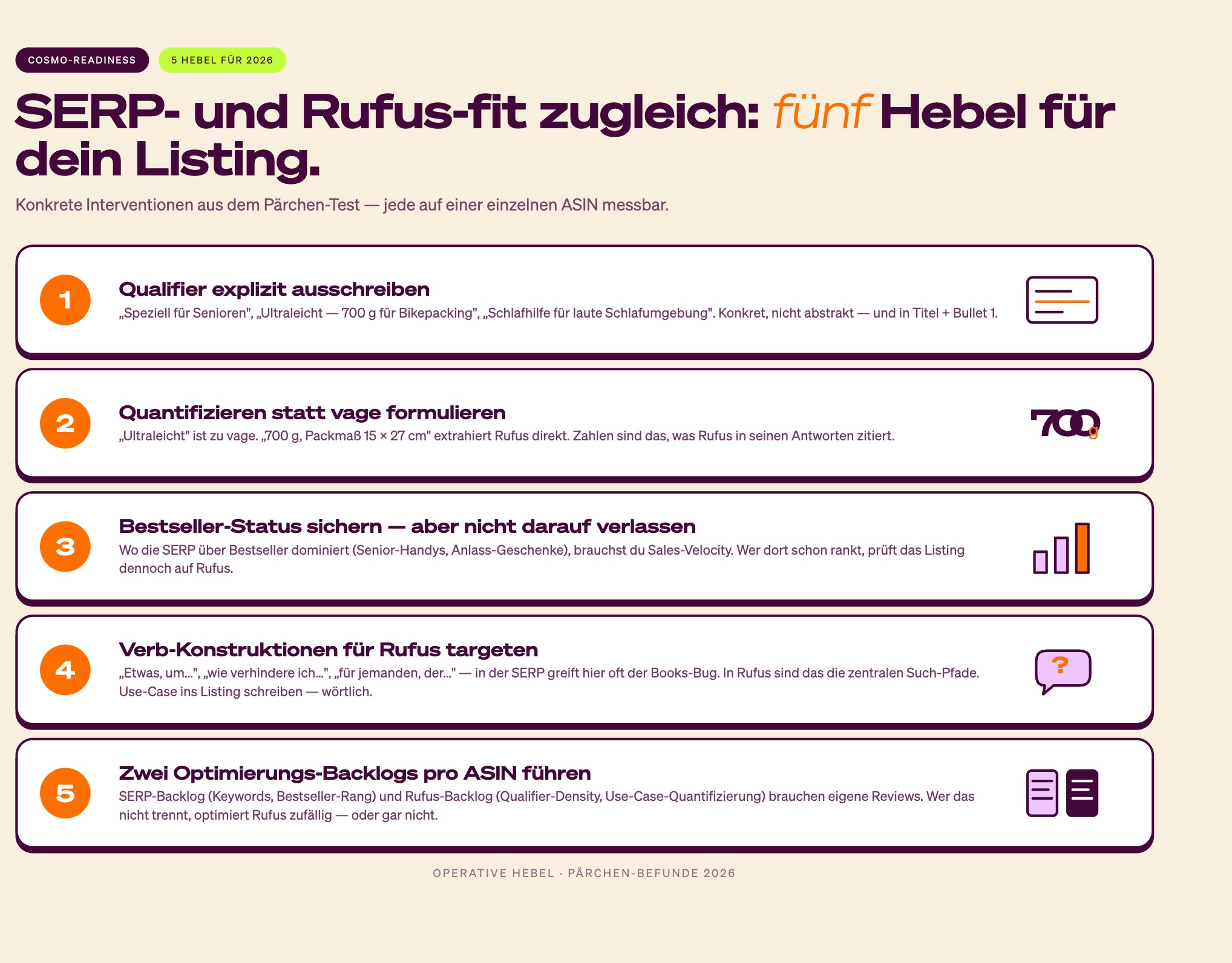
Fig. 8: The five operational levers derived from the findings of the pairs. Each lever can be measured on a single ASIN. Source: Valuezon 2026.
The four pairs result in five specific areas of work. Each lever can be measured for an individual ASIN.
Write qualifiers explicitly
If you’re selling senior phones, bikepacking sleeping bags, or sleep receiver solutions, the use-case belongs in the title and in Bullet 1—not hidden in A+ Content. Rufus extracts exactly from these fields. You write “Specifically for senior users,” “Ultralightweight (700 g) for bikepacking & trekking,” “Sleep aid for noisy sleeping environment.” Concrete, not abstract.
Quantify wherever possible
“Ultralightweight” is too vague for Rufus. “700 g, packed size 15 × 27 cm” is clear. “Noise-cancelling” is standard. “45 dB noise reduction through foam deformation” is differentiated. Numbers are what Rufus cites in its responses as soon as they appear in the listing.
Secure bestseller status, but don’t rely on it
In the grill case and the grandma phone case, the SERP dominates over bestseller rank and occasion clichés. If you want to become visible there, you need sales velocity. If you’re already visible, you should still check your listing with Rufus, because a bestseller in the SERP isn’t necessarily a bestseller in Rufus.
Purposefully target verb constructions and long-tail queries for Rufus
“Something to…,” “How do I prevent…,” “For someone who…” These formulations often do not yield matching products in the DE-SERP (books bug, zero-SERP). In Rufus, however, they are the main search paths. If your product is made for such use-cases, write the use-cases explicitly in the listing.
Maintain two backlogs per ASIN
The SERP backlog is what you already know: keywords, bestseller rank, review velocity. The Rufus backlog is new: qualifier density, use-case quantification, cluster label match. Both backlogs need their own reviews. If you don’t separate the disciplines, you’ll optimize for Rufus either by chance or not at all.
These five points are what we at Valuezon consider Cosmo-Readiness. They are measurable for each ASIN individually and directly contribute to what the four pairwise tests reveal.

Frequently Asked Questions
Does this mean classic Amazon SEO is dead?
No. In control queries and bestseller categories, the SERP still works reliably. A9 isn’t gone; A9 is just playing a narrower game than expected. However, long-tail and persona queries are shifting significantly towards Rufus. SEO remains necessary but is no longer sufficient for long-tail visibility.
Why did Rufus win completely in one case and only partly in another?
Because Rufus shines when the secondary condition can be clearly translated into product features (weight, use-case, persona). Rufus shines less when many products signal the same feature (all senior phones have “large buttons”). The SERP benefits when the token set of the query and the token set of the listings overlap.
What is the books bug, and does it only occur in DE?
An indexing path in the DE-SERP that interprets verb constructions like “something to…” or “how do I prevent…” as potential book title triggers, pushing books into the top organic results. In the “snorer” case, all five top organic results are books. This pattern does not occur in the US. It is DE-specific and persistent. We measured it again after six days—the bug remains.
Can you directly measure your Rufus visibility?
Not via a dashboard provided by Amazon. Indirectly, yes—through regular spot checks in the long-tail queries relevant for you. At Valuezon, we integrate these retest cycles into BoostAI reporting with a Cosmo-Readiness score per ASIN.
How current are the findings?
Initial survey of the four pairs at the beginning of May 2026, retest six days later (all findings stable). Rufus in DE continues to run in beta status. We recommend monthly retest cycles because Rufus responses and the SERP indexing change faster than with traditional annual SEO.
Is this a scientific study?
No. Four pairs make a sample, not proof. The findings are reproducible and fit the pattern of a larger 30-case sweep that we are conducting in parallel. The full material is in the Valuezon archive and can be shared upon request.