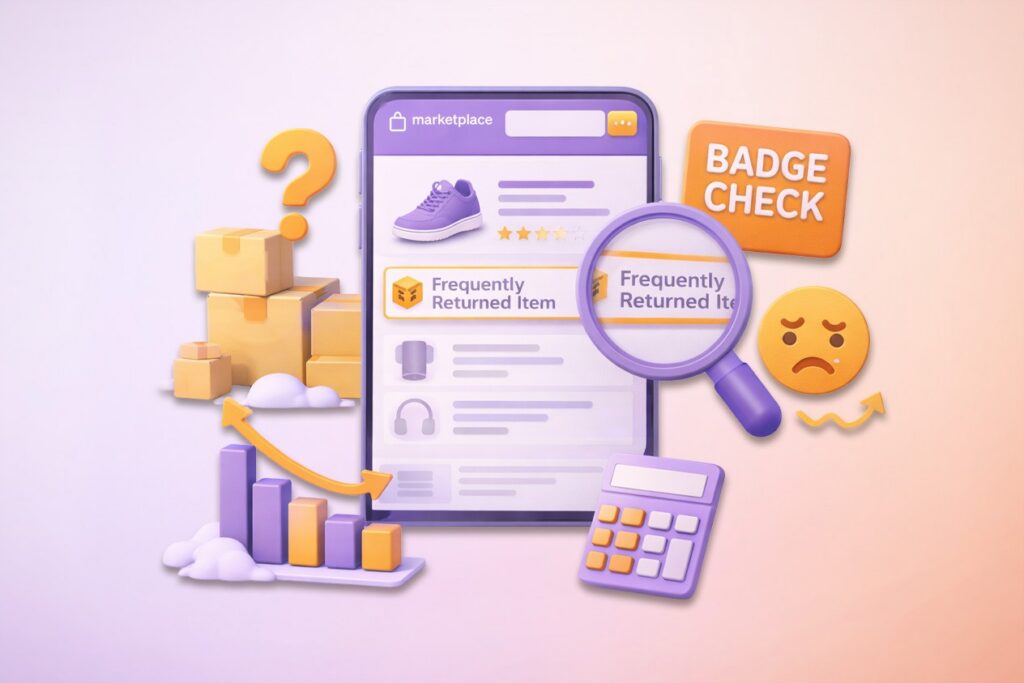
Amazon has introduced the “Frequently Returned Item” badge to inform customers about products with an above-average return rate. While this may sound like more transparency for buyers, it can become a real challenge for you as a seller. In this article, you will learn how the badge works, what impact it has on your conversion rate, and what you can do about it.
Badge Display: Where and how does it appear?

The badge appears on your product detail page—sometimes in red directly below the title, sometimes in yellow underneath the bullet points. It seems Amazon is still testing where and how it is displayed.
The badge is shown on the product detail page and indicates to customers that the item is frequently returned—sometimes even showing the most common return reasons. When it comes to the exact placement and design, Amazon is clearly still experimenting.
Position and Color Scheme
In some cases, the badge appears in red below the title—which is the worst-case scenario. In other cases, it shows up in yellow beneath the bullet points.

Fig. 1: Amazon product detail page – Frequently Returned Item
Display on Different Platforms
The badge display can vary depending on browser (e.g., Firefox, Chrome), usage mode (e.g., private mode), or platform (e.g., mobile app, desktop). These inconsistencies can confuse customers and influence the perception of your product.
Subscribe to our newsletter and receive fresh updates every two weeks.
Impact on Conversion Rate
For you as a seller, the badge can have significant effects on sales numbers. Some sellers report drastic drops in conversion rates as soon as the badge appears on their products. In some cases, products became almost unsellable, resulting in storage costs and other financial burdens.
How is the badge assigned?
Criteria for Assignment
Amazon assigns the badge based on a complex and for manufacturers and sellers non-transparent system, which takes the following factors into account:
- Return rate compared to the product category: Products with a significantly higher return rate than the average of their category are at risk.
- Current sales figures: Only listings with sufficient sales velocity are considered.
- Initiated returns: The number of initiated returns counts, not just those actually completed.
- Average return rates of similar products: Amazon also includes peer group data as reference values.
- Different time intervals: The key figures from the last 3 and the last 12 months are taken into account.
The exact thresholds are not publicly known and may vary by (sub-)category. In one case, the relevant return rate was around 12%, in others it was significantly above or below. Even within a parent ASIN, no consistent pattern can be detected—the badge can be selectively assigned to individual variants. Amazon evaluates each ASIN individually.
Criticism
Many sellers express concerns about the transparency and fairness of the system:
- Lack of transparency: The criteria for badge assignment have not been clearly communicated. In the European Seller Central, the necessary details for in-depth root cause analysis are not yet provided, making it hard for you as a seller to implement targeted countermeasures.
- No correlation with customer experience status: It is hard to explain why within one parent, an ASIN with good customer experience and a lower return rate gets the badge, while another with poorer customer experience and a higher return rate does not.
- False information from customers: Returns with intentionally false reasons—such as to receive free return shipping—are included in the calculation of the metric without adjustment.
In the US, Amazon already provides sellers with more detailed return data – including a long-term and short-term return rate, as well as a suggested return rate as a target value.

Fig. 2: Amazon Seller Central – Customer Experience
Strategies to Avoid or Remove the Badge
Although the badge is assigned automatically, you can proactively take measures to remove it, minimize the risk, or generally reduce your return rate:
- Analyze customer feedback: Use the “Voice of the Customer” dashboard and reviews to identify common reasons for returns and make corresponding adjustments to your content or the product itself.
- Optimize product detail pages: Ensure that your descriptions are precise and complete—including accurate size charts, dimensions, and high-quality product images.
- Improve product quality and packaging: Make sure your products meet customer expectations and are securely packaged to avoid shipping damage.
- Monitor returns: Regularly check the development of your return rate and take action when necessary.
The badges are reviewed regularly and are removed again if return rates decrease.
Conclusion
The “Frequently Returned Item” badge is Amazon’s attempt to increase customer satisfaction—but it can present significant challenges for you as a seller. One particularly critical point is the lack of transparency in the assignment system: The criteria often seem arbitrary, and many sellers cannot discern a clear pattern. Exact thresholds and influencing factors are not communicated, making it difficult to take targeted countermeasures.
If you regularly check your product pages, take customer feedback seriously, and consistently analyze reasons for returns, you can not only avoid the badge but also strengthen buyers’ trust in the long term. Now is the right time to critically examine existing processes and future-proof your listings.