
You advertise 14 days of battery life in your product description. A hundred customers, however, write in their reviews that the battery is empty after 8 to 10 days. Who does Amazon’s AI believe? The reviews, every time. Your customers are quietly editing your listing, and Rufus is paying close attention. Here you’ll learn how Rufus analyzes reviews, what the review override effect is, and how to sync your listing with your product’s actual performance.
How Rufus Evaluates and Uses Your Reviews

Rufus doesn’t read individual reviews, but analyzes the entire review base. From that, the AI creates its own picture of your product—ultimately influencing who even gets to see your listing.
At a glance:
- Rufus analyzes the sentiment of your reviews and extracts specific factual statements from them
- In many cases, reviews carry more trust weight than your own listing text
- Frequently mentioned features become semantic connections, even if they never appeared in your listing text
- Recurring problems harden into well-known weaknesses of your product
Rufus doesn’t read reviews like a person scrolling through the first five testimonials. The system processes the entire review base using natural language processing methods and distills two things: a sentiment (positive, neutral, negative—per product aspect) and structured factual statements about your product.
Here’s a practical example. If many customers write phrases like perfect for travel, easy to carry, fits in any backpack, then Rufus learns that your product is suited for mobile users. This information will be considered in future queries, even if words like travel or backpack never actually appeared in your listing copy. Your customers have essentially added a semantic dimension to your listing that you never actively defined.
This works both ways. If 22 percent of your reviews mention broken or defective, the system flags a risk factor. If 15 percent mention durable, that’s a trust signal. Both attributes, positive and negative, flow equally into the semantic description of your product. You can’t prevent this analysis; but you can ensure your listing sends the right signals by being honest and precise.
The key point: reviews count as independent experiential data. Your listing text is advertising—and the AI knows it. Reviews, on the other hand, come from people who purchased and used the product. That’s exactly why, in case of contradiction, reviews are often given more weight.
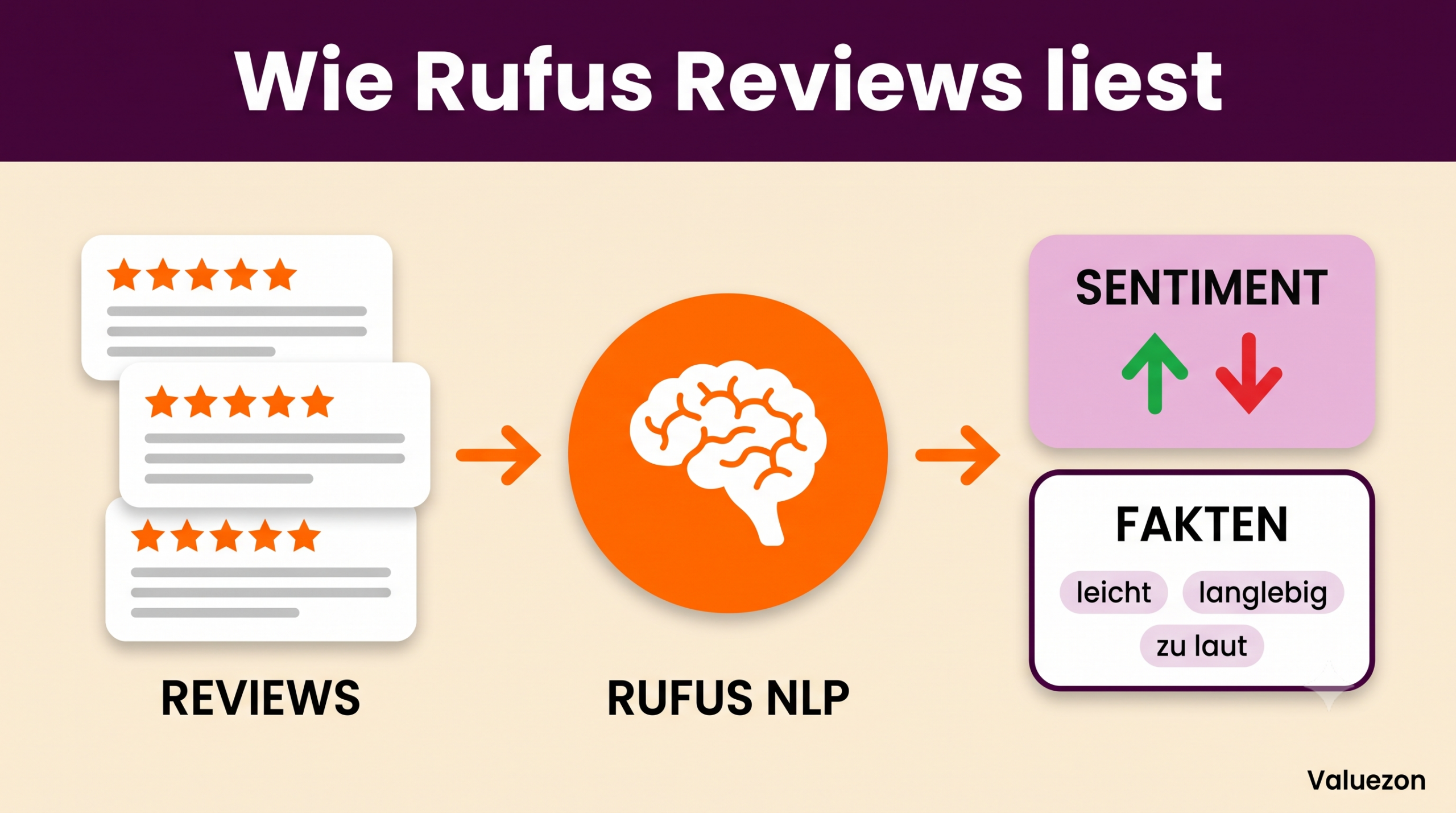
Fig. 1: Rufus distills sentiment and concrete factual statements from hundreds of reviews—both become ranking signals. Source: Valuezon, own illustration.

Subscribe to our newsletter and get fresh updates every two weeks.
The Review Override Effect in Practice
At a glance:
- If reviews contradict your listing, the crowd usually wins
- Common discrepancies: color, noise level, size, build quality, delivery time
- Just a few consistent critical reviews can flag a feature as problematic
- The effect intensifies as more customers independently report the same problem
The review override effect describes the moment when collective customer perception overwrites your own product description. You claim water resistance up to 50 meters. Forty-seven out of 500 buyers note that water seeped in at just 2 meters’ depth. For Rufus, the conclusion is obvious: this claim is unreliable. Future buyers will either see this uncertainty for water-related queries or your listing may not show at all for these searches.
The key word here is collective. A single negative review rarely overturns an entire feature. But as soon as several customers independently report the same issue, a pattern forms—and patterns are exactly what an AI system is trained to detect. Three reviews saying the cable doesn’t last outweigh their star ratings. They define a weakness.
Most common cases: Color deviation (product photos show silver, but it’s actually more gray), noise level (a fan is described as far too loud, even though the spec sheet says 55 dB), size (significantly smaller than expected, despite correct centimeter specifications), build quality (cheaply made, even though positioned as premium), and delivery time (arrived after three weeks, contradicts 2-3 day shipping promise).
Notably, in most of these cases, the listing isn’t even lying. The dimensions are accurate, the decibel level is correct. The problem is the expectation gap between what you communicate and what customers actually perceive. This exact gap is the lever that proactive review management addresses. You can’t change your product’s reality overnight, but you can manage expectations so there’s less disappointment.
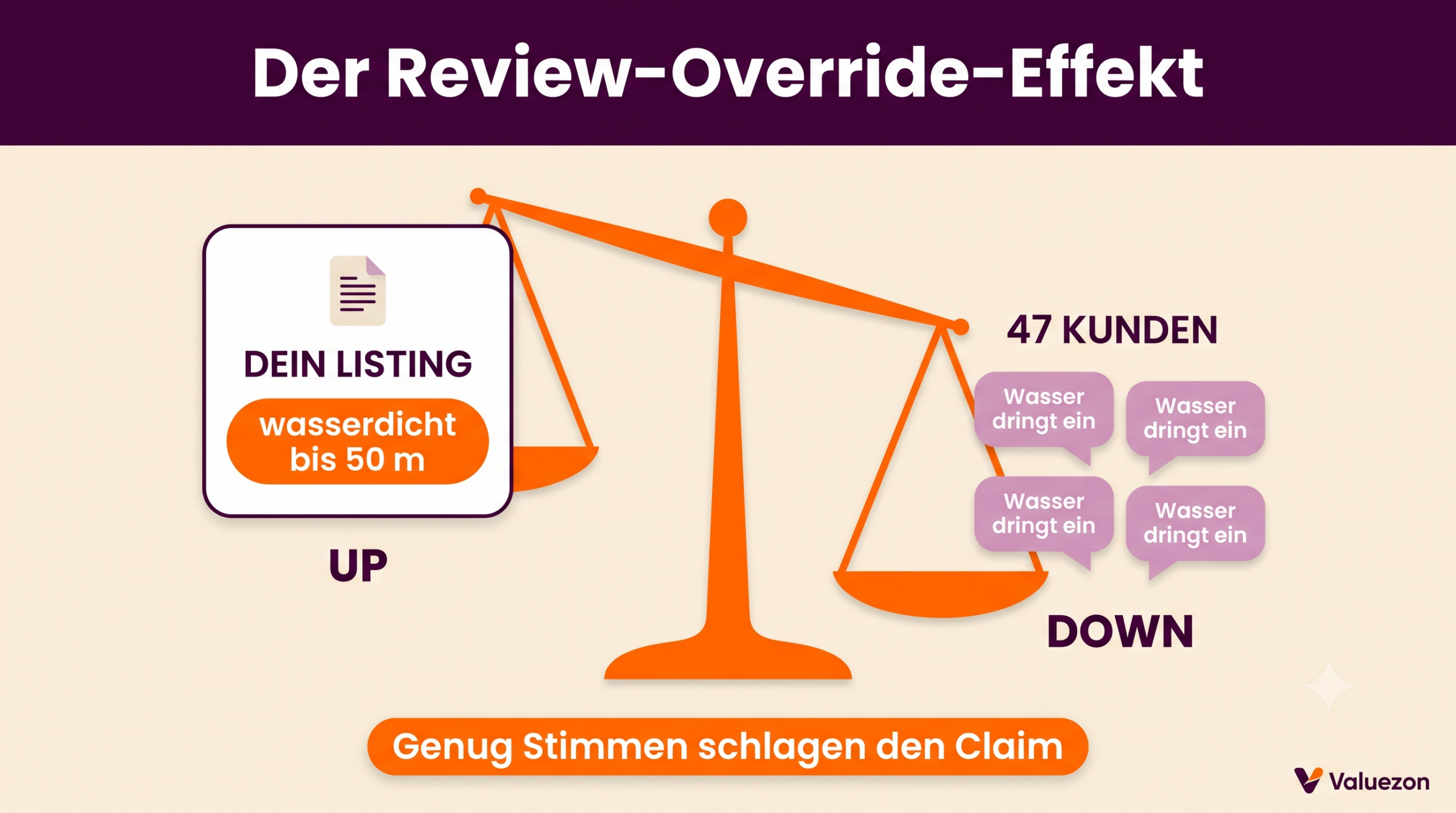
Fig. 2: Listing claim versus crowd experience. As soon as enough customers disagree, the crowd wins—and Rufus believes them. Source: Valuezon, own illustration.
Strategies for Proactive Review Management
At a glance:
- Systematic monitoring of review trends is your early warning system
- Quick, factual responses to critical reviews reduce their impact
- Regular listing updates based on real feedback are more effective than rare full overhauls
- Proactive Q&A posts clarify misunderstandings before they turn into negative reviews
Review management doesn’t mean manipulating ratings. It means bringing your listing into alignment with the lived reality of your product—before the crowd defines this reality for you. Two typical scenarios show what this looks like in practice.
Scenario 1: Size Issue Trending. In your last 50 reviews, eight customers mention sizing problems. The average is still 4.5 stars, but the trend is clear. Instead of waiting for a “too small” pattern to set in, you activate your image and copy strategy: a product photo now shows the size with a reference object (hand, coin, everyday item). In the listing text, you get even more specific about dimensions. In the Q&A, you post and answer a detailed question about size, including a specific comparison. Result: Future buyers have more realistic expectations and are less likely to leave disappointed reviews.
Scenario 2: Recurring Product Signal. You find three critical reviews with the same theme: the cable doesn’t last long. This is no longer a coincidence—it’s a product signal. Here, you respond publicly and professionally. You thank users for their feedback, explain transparently that the cable reinforcement has been improved, and offer assistance. This shows customer focus and signals that the issue is taken seriously and addressed—not ignored.
Response speed is a lever of its own. A critical review left unanswered for weeks has a very different impact than one with a factual, solution-oriented response within 48 hours. For real buyers, this signals an active, responsible seller. It also gives you a chance to publicly correct misinformation before it becomes accepted as fact about your product.
How COSMO Integrates Review Sentiment into the Knowledge Graph
At a glance:
- COSMO scans your review base and extracts structured attributes
- Frequency patterns become factors relevant to ranking
- Positive and negative attributes are fed equally into the product model
- The analysis cannot be prevented—you can only influence the input
Behind Rufus works COSMO, Amazon’s commonsense knowledge graph. COSMO connects products to attributes, use cases, and target groups via semantic relationships. Reviews are a particularly valuable data source for this graph because they describe specific use contexts in natural language—exactly what COSMO is designed to model.
In practice, this means: COSMO reads from “perfect for the office” a link to the office use location, from “ideal as a gift” a link to the gifting occasion, from “lasts forever” a trust signal for durability. These relationships, derived from reviews, supplement those in your listing copy. In the best case, they reinforce each other. In the worst case, they contradict—and the contradiction itself becomes a negative signal.
This is the strategic crux. You can’t prevent COSMO from reading your reviews. But you can increase the chances that the right terms appear in those reviews by clearly communicating these use contexts in your listing—and having your product genuinely fulfill them. Customers who read “ideal for travel” in the listing and have their expectations met are very likely to phrase it that way in their review. This way, you indirectly feed the knowledge graph without manipulating a single rating.
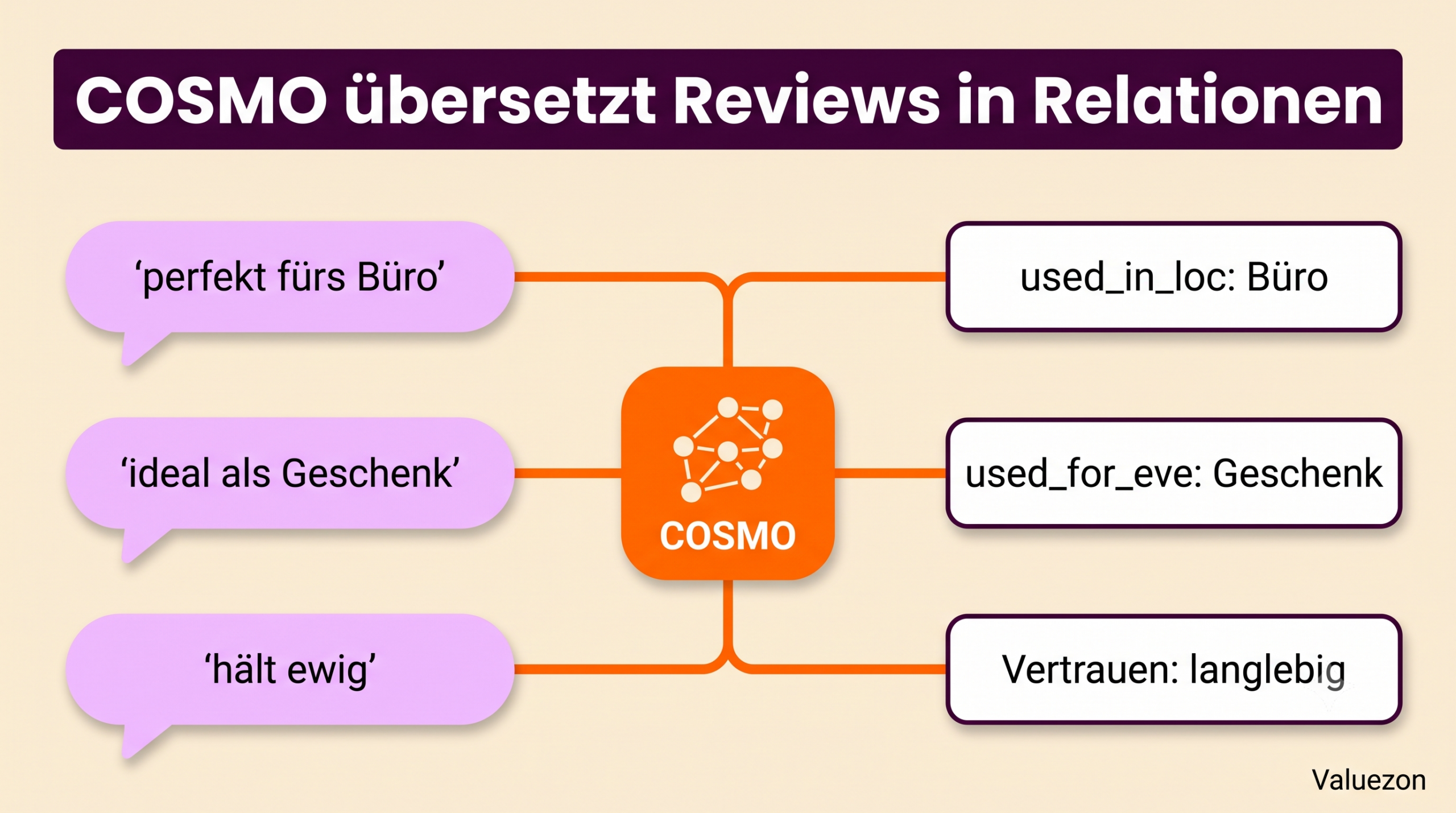
Fig. 3: From review wording, COSMO constructs semantic relationships—use location, occasion, and target group—directly from your customers’ words. Source: Valuezon, own illustration.
Monitoring: Your Early Warning System
At a glance:
- Amazon Brand Analytics and Voice of the Customer show you review trends
- External tools like Helium 10 or AMZScout help with systematic tracking
- In most cases, a weekly sample of your 20 latest reviews is sufficient
- The frequency of certain terms in reviews is your best early indicator
You don’t need to build a complex infrastructure to keep an eye on review trends. Consistency is what matters, not completeness. Spending just five minutes once a week checking your most recent reviews will help you spot emerging issues weeks before someone who only reacts when their star rating drops.
What you should monitor weekly or monthly: average star rating and its trend, the most frequent words in your low ratings (1 to 3 stars), your response rate to critical reviews, and any new patterns of criticism that haven’t appeared before.
The most valuable indicator is term frequency in negative reviews. If size or noise suddenly shows up more often in your negative reviews, you get an early warning long before it impacts your average rating. Amazon’s own Voice of the Customer dashboard in Seller Central provides a free foundation for this. Specialized tools can give you even more granular insights.
From Analysis to Action: Listing Updates Driven by Review Patterns
At a glance:
- Reviews should be your primary input for improving your listings, not gut feeling
- Proven cycle: Analyze, hypothesize, update, monitor
- Small, frequent updates outperform large, rare overhauls
- Document every change so you can later track its impact
Reviews are the most honest product research you can get—and it’s free. Instead of guessing which bullet point to rewrite, let your customers tell you. The process is deliberately simple so you actually stick with it: read reviews monthly and identify patterns, form a hypothesis about the core problem, implement a targeted update (image, bullet point, description, or Q&A), log a baseline metric, check again after six weeks, and learn from it.
The most important methodological principle is small, frequent iterations. A large listing overhaul once a year makes it impossible to tell which of your twenty changes actually moved the needle. Three targeted mini updates per quarter, each with a clear hypothesis and solid baseline, will give you real insight about your product and your market. Make sure to document every change with the date, or you’ll lose the link between action and result.
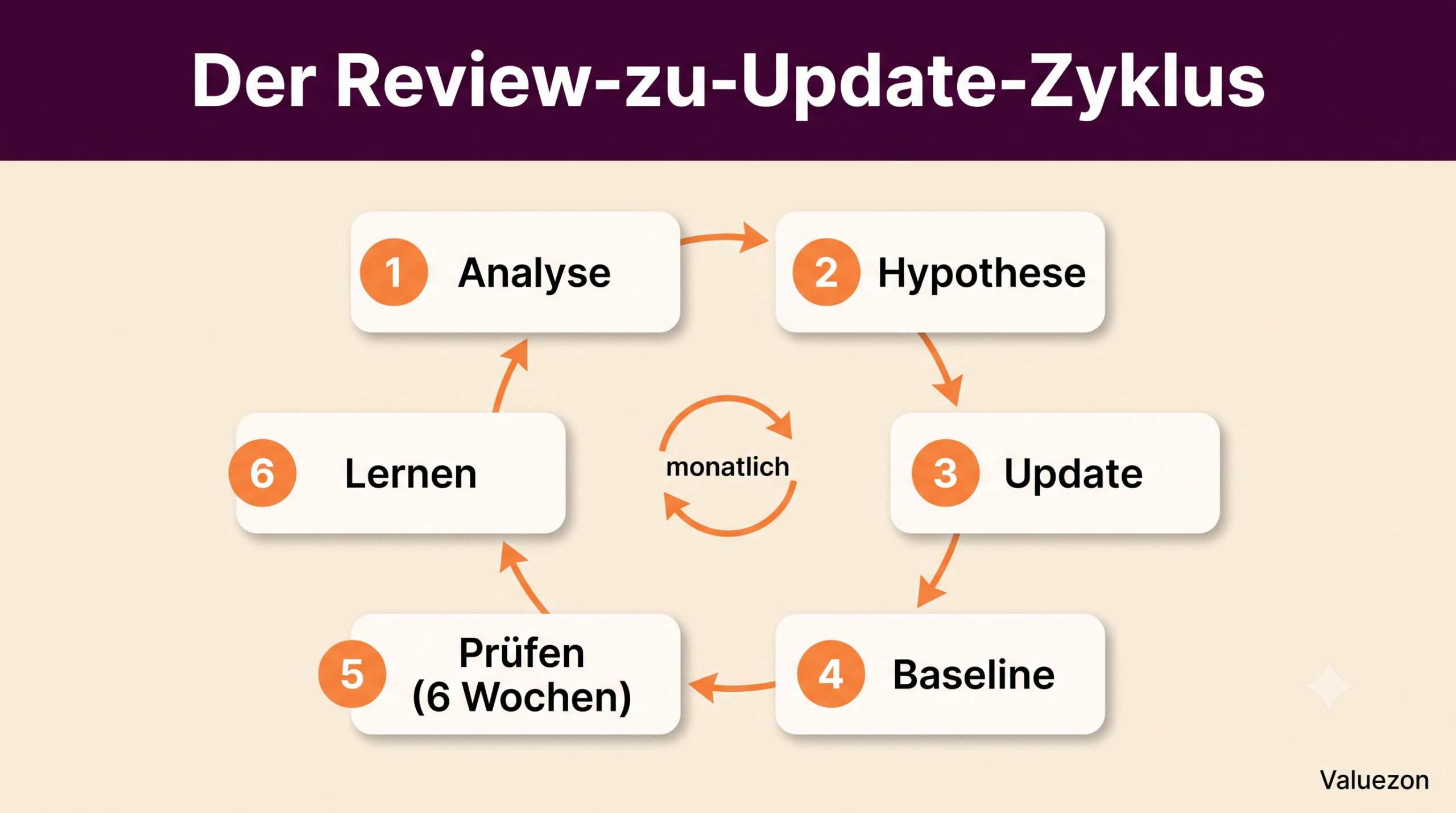
Fig. 4: The review-to-update cycle, from pattern analysis and hypothesis to measuring results after six weeks. Source: Valuezon, Own illustration.
Q&A Management as a Second Trust Signal
At a glance:
- The Q&A section is viewed by Rufus as additional verified information
- Fast, helpful answers directly influence purchase decisions
- Q&A works defensively: incorrect assumptions can be actively corrected
- Self-posed, factual questions are an underrated lever
While reviews reflect the experience with your product, the Q&A section represents the clarity before purchase. The two are connected: if your listing is unclear, it leads to misunderstandings, and these end up as disappointed reviews. Clarifying ahead of time in Q&A helps prevent bad reviews before they ever happen.
A practical example: Your product is a yoga mat. The latest reviews complain it’s too thin. In Q&A, you proactively pose the question about the mat’s thickness and honestly answer: 5 mm—perfect for classic yoga, intentionally thin for better floor contact, and for knee-friendly practice with an additional pad. This achieves two things: buyers with the wrong expectation are less likely to purchase and, therefore, less likely to leave negative reviews, and Rufus receives an additional, consistent data point regarding the thickness and purpose of your product.
Q&A entries are seen as semi-verified statements by Rufus, because they’re public and visible to the community. False or outdated claims in old Q&A answers should be treated just as seriously as mistakes in the listing text. A single misleading Q&A entry from last year can create customer expectations that result in negative reviews today.
Your Action Plan for This Week
At a glance:
- Start with your three most important listings
- Analyze the 30 most recent reviews for each
- Identify discrepancies between your listing and the reviews
- Implement one small, specific improvement per listing
Review management isn’t a one-time project—it’s an ongoing dialogue between your listing and your customers. The sooner you take this conversation seriously, the faster Rufus works for you instead of against you. Start small this week: Choose your three best-selling listings. For each, read the latest 30 reviews and highlight any comment that contradicts your listing copy. Find the one pattern that comes up most frequently. Make one targeted change per listing: more precise images, a clearer bullet, or a proactive Q&A entry. Note the date and baseline. In six weeks, check back to see what’s changed.
The winner in this game isn’t the one who sells most convincingly, but the one who communicates the truth about their product most clearly. Because your customers will write that truth in their reviews regardless—and Rufus is reading along.

Frequently Asked Questions about Review Management and AI
Does Amazon’s AI really read my customer reviews?
Based on Amazon patents and observations, yes: Rufus and the COSMO Knowledge Graph use reviews as a data source. They analyze sentiment and extract specific statements about features and usage context. Amazon does not officially confirm the exact weighting, but the AI’s behavior in practice can only be explained this way.
What is the Review Override Effect?
The Review Override Effect describes the moment when the collective experience of your customers overrides your own listing claims. If enough reviews contradict one of your promises—for example, waterproof—the AI treats your claim as unreliable and your product will be shown less often for relevant searches.
Can a single negative review ruin my ranking?
Usually not. Individual outliers have little impact. It becomes critical when several reviews independently describe the same issue. That’s when a pattern emerges—and patterns are exactly what AI systems respond to. That’s why recurring issues are more important than a single one-star review.
Is proactive review management considered manipulation?
No—as long as you don’t buy, fake, or push customers for positive reviews. Proactive review management means aligning your listing with the reality of your product: clearly setting expectations, responding objectively to critical feedback, and improving your product based on genuine input. This is legitimate product and listing optimization.
How often should I check my reviews?
For most sellers, a weekly sample of your 20 newest reviews is sufficient. Focus less on the average rating and more on how often certain terms appear in negative reviews. If a particular issue suddenly comes up more frequently, that’s an early signal—long before your star rating noticeably drops.
Sources
The mechanisms described in this article are based on publicly available Amazon patents (including those related to the COSMO Knowledge Graph), scientific papers on AI-powered product search (Amazon Science, amazon.science), as well as the official introduction of the Rufus AI shopping assistant (About Amazon, aboutamazon.com). The Voice of the Customer dashboard is part of Amazon Seller Central (sell.amazon.com). Amazon does not publish official details on their internal ranking algorithms. Statements on the weighting of individual signals are plausible model assumptions, not confirmed facts. Additional insights are based on Valuezon’s own optimization experience (review sentiment analysis, 2025 and 2026).