Rufus is currently recommending a competitor’s product to your customer. Not because it’s better, but because the listing is better explained. When asked, “Which headphones are suitable for sports?”, Rufus found an answer—but not in your listing.
What are the Rufus factors and why do they determine quotability?

Keywords are no longer enough. Rufus quotes listings that provide clear, evidence-backed answers to typical customer questions. Ten factors determine whether your listing will be included.
In Blog 3, we introduced Rufus as an AI shopping assistant and showed how it influences purchasing decisions. Blog 4 focused on the 15 COSMO relations—the knowledge network Amazon builds around your product even before Rufus answers. Now comes the next step: the 10 Rufus factors. They determine whether Rufus actually quotes your listing or ignores it.
COSMO describes what Amazon knows about your product. The Rufus factors describe how well your listing is prepared for AI-generated answers. Together, they make up the 25 points of the Boost^AI Score framework: 15 COSMO relations plus 10 Rufus factors.
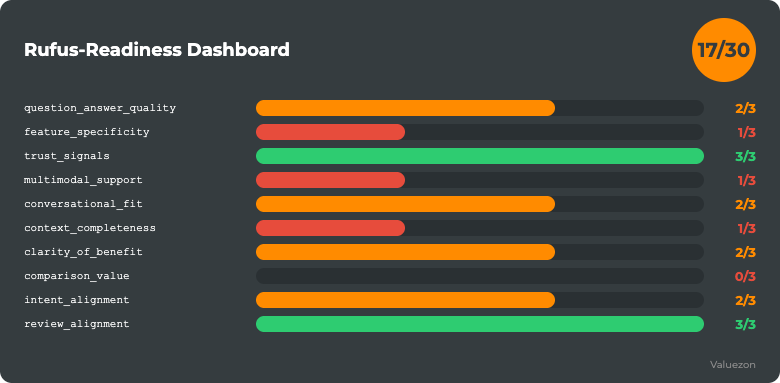
Fig. 1: The Rufus Readiness Dashboard: each of the 10 factors evaluates a different aspect of AI quotability. Source: Valuezon / Own illustration 2026
Note: The factor names used in this article such as
question_answer_qualityorreview_alignmentare Valuezon’s own conceptualizations developed based on the publicly documented Rufus architecture and observable ranking signals. Amazon has not officially released the internal weighting parameters. This system is part of the proprietary Boost^AI Score framework.
At a glance:
- COSMO is the knowledge network (what Amazon knows about your product).
- Rufus factors are the quotability layer (how well the knowledge is presented for retrieval).
- Keywords alone are no longer enough. Rufus needs structured, quotable answers.
- 10 factors, each worth 0 to 3 points. Maximum Rufus score: 30 points.
- Together with the 15 COSMO relations, this produces the 25-point Boost^AI Score.
Imagine you ask a librarian for a book about sustainable energy generation. She might say: “Somewhere on shelf 7.” Or: “The standard work by Meyer, published in 2023, is on shelf 7, section 3, green cover.” Rufus is that librarian. Your listing is the book.
COSMO vs. Rufus factors: What’s the difference?
The 15 COSMO relations (detailed in Blog 4) describe the semantic knowledge network Amazon builds around your product: has_property, is_used_for, targets_audience, and so on. COSMO is the knowledge, the facts.
The Rufus factors describe something else: the quality of the presentation of this knowledge from the AI assistant’s perspective. Can Rufus find a citable, clear answer to a customer question in your listing and use it as output? That’s what this is about.
Many sellers still think in terms of keyword density. The more important question today: Would a journalist want to cite your listing as a source? Rufus works on exactly that principle.
Why quotability is more important than keywords
Traditional listing optimization focuses on keyword relevance—placing the right terms in the title, bullets, and description. That remains essential, no question. But it has become the basic requirement, not the differentiator.
Rufus generates answers. For that, it doesn’t need keyword density. It needs statements that it can use, either paraphrased or nearly verbatim. A listing that gives a clear answer to a typical customer question in a single sentence gets quoted more often than one that hides the same keywords spread out over twelve bullet points.
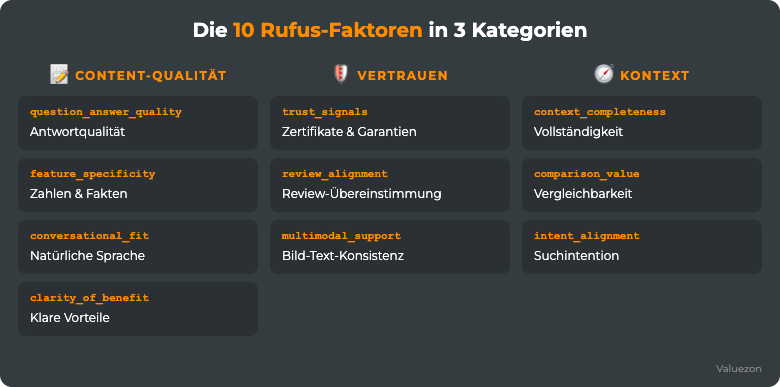
Fig. 2: The 10 Rufus factors grouped into three categories: answer quality, trust, and comparability. Source: Valuezon 2026

Subscribe to our newsletter and receive fresh updates every two weeks.
Factor 1: Is your listing an answer machine? (question_answer_quality)
At a glance:
- Rufus asks customer questions. Your listing needs to provide answers.
- The best bullet point starts with the answer, not the feature.
- Structure: [answer to implicit question] + [evidence/context].
- Scoring: 0 = no answer structure, 3 = every bullet is an answer.
Rufus internally evaluates how well a listing can answer typical customer questions. The questions are predictable: “Is it waterproof?”, “Is it suitable for children?”, “How long does the battery last?” If your listing answers these questions, it will be preferred as a source.
Before/After example:
Before (feature-centered): “IPX5 protection against splashes thanks to advanced nano-coating technology.”
After (answer-centered): “Yes, waterproof: IPX5 protection stands up to rain, sweat, and splashes. Ideal for outdoor sports.”
The second sentence answers the implicit question, “Can I wear this while exercising if it’s raining?” Rufus can almost use it one-to-one as an answer.
💡 Tip: Write every bullet point as if a customer is asking exactly this one question. Start with the result (“Yes, waterproof”), then the technical proof (IPX5), then the context (outdoor sports). That’s Rufus-native.
Factor 2: Numbers beat adjectives (feature_specificity)
AI systems prefer quantifiable statements over value judgments. “Excellent battery life” means nothing to Rufus, because he can’t answer a query with it. “32 hours battery life,” on the other hand, can be used in a comparison answer: “Product A has 20 hours, Product B has 32 hours of battery life.”
Adjectives like “long,” “powerful,” or “high-quality” are worthless for Rufus. Scoring: 0 = only adjectives, 3 = all claims backed with numbers.
Before/After example:
Before (unspecific): “Powerful battery for long music enjoyment even on the go.”
After (specific): “32 hours battery life (ANC on). 10 minutes charging = 3 hours of music via quick charge.”
Three numbers. Two implicit questions answered: “How long does the battery last?” and “How fast does it charge?”
💡 Tip: Go through each feature in your listing and ask yourself: “Can I back this up with a number?” If yes, drop the adjective. If not, consider whether the feature is relevant at all. Rule of thumb: every feature bullet should contain at least one measurable detail.
Factor 3: Trust through proof (trust_signals)
When Rufus recommends a product to a customer, Amazon’s reputation is on the line. That’s why Rufus favors listings with verifiable trust signals, similar to Google E-E-A-T for web content. Scoring: 0 = no trust signals, 3 = several well-placed pieces of evidence.
Before/After example:
Before (without trust signal): “High-quality materials for maximum wearing comfort.”
After (with trust signals): “TÜV-tested wearing comfort, 2-year guarantee included, 15,000+ verified reviews (Ø 4.7 stars).”
Three quotable trust signals: external certification, guarantee promise, aggregated social proof.
💡 Tip: Prioritize by verifiability: external certificates (TÜV, CE, FDA) > time-limited guarantees > review aggregates > brand statements. External certifications have the highest individual value.
Factor 4: Text and images tell the same story (multimodal_support)
Amazon Rufus processes images, text, and structured data simultaneously. A multimodal AI system. An image showing something not mentioned in the text is a missed opportunity for reinforcement. Even worse: an image contradicting the text lowers the trust score. Scoring: 0 = images unrelated to the text, 3 = every main feature is visually supported.
Before/After Example:
Before (text and image disconnected): Text: “IPX5 water protection” · Image: Studio photo on a white background without context
After (text-image consistency): Text: “IPX5 water protection, ideal for sports in the rain” · Image: Wearer with headphones running in the rain
The second scenario reinforces the same message through two channels. Rufus evaluates both as congruent evidence.
💡 Tip: This factor is covered in detail in Blog 6 (Multimodal Listing Design). Quickest immediate action: Make a 1-to-1 match between your top 3 features and your top 3 product images. Every main feature needs a matching image.
Factor 5: Write the way customers ask (conversational_fit)
When a customer asks Rufus, “Which headphones are best suited for working from home?” he expects something that feels like a human recommendation. Not an ad. Listings written in natural language are easier for Rufus to paraphrase and appear more credible in the AI’s response. Scoring: 0 = pure marketing language, 3 = fully conversational phrasing.
The second text sounds like an answer from an experienced colleague. Rufus can pass it on as a recommendation without it sounding like advertising.
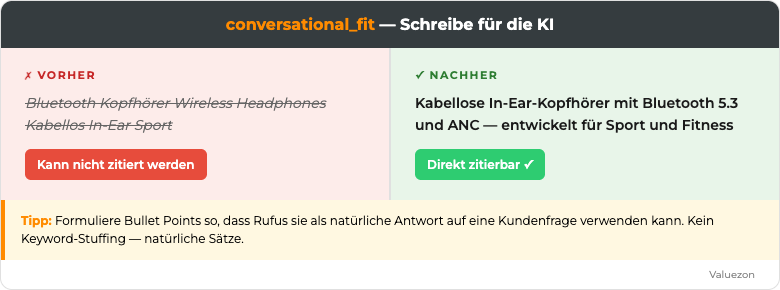
Fig. 3: Before/After: Marketing language (“revolutionary, unparalleled”) is replaced by natural, conversational wording. Source: Valuezon 2026
💡 Tip: The “read-aloud test” helps. Read each bullet point out loud and imagine you’re explaining the product to a friend on the phone. Does it sound natural? Or does it sound like an ad? Anything that sounds “marketingy” when read aloud needs to be reworked.
Factor 6: Cover all scenarios (context_completeness)
At a glance:
- Rufus answers situation-based questions. Your listing needs to cover the most important scenarios.
- Every use scenario not mentioned is a missed citation opportunity.
- For whom, when, where, and why is the product suitable?
- Scoring: 0 = only one scenario, 3 = all relevant use cases named.
Customers ask Rufus situational questions: “Can I use the headphones while cooking?”, “Is this suitable for frequent travelers?”, “Is this a good gift?” For each of these, Rufus searches for context in your listing. If he doesn’t find any, he quotes another product.
Before/After Example:
Before (single scenario): “Perfect for music lovers.”
After (multi-scenario): “Suitable for: Home Office (ANC filters office noise), commuters (foldable, 32h battery), sports (IPX5, secure fit), frequent travelers (airplane adapter included).”
One sentence answers four questions.
💡 Tip: Write down the five most common purchase occasions for your product (personal use, gift, work, sports, travel, depending on the category). Each occasion you mention in the listing is an additional quoting opportunity for Rufus.
Factor 7: The customer wants benefits, not features (clarity_of_benefit)
There is a classic mistake in Amazon listing writing: feature dumping. Sellers list what the product has, but not what the customer gets out of it. Rufus generates its answers from the customer’s perspective and therefore prefers listings that clearly state the benefits. Scoring: 0 = pure list of features, 3 = every bullet point includes a customer benefit.
Before/After Example:
Before (Feature Dump): “40-mm neodymium drivers with extended frequency response from 20 Hz to 20 kHz.”
After (Benefit-First): “Rich, detailed sound. You’ll feel bass you can physically sense, and highs in your favorite songs you never noticed before.”
The first sentence is understandable for audiophiles. The second one is for the average customer, and therefore quotable by Rufus.
💡 Tip: The “So-What Method” is reliably effective. Write down the feature, then ask: “And what does that do for the customer…?” The answer is the benefit. Ideally, you combine both: the feature as proof, the benefit as relevance. Example: “40-mm drivers = rich sound you can physically feel during bass lines.”
Factor 8: Make Your Product Comparable (comparison_value)
“What is the difference between Product A and B?” is one of the most frequent Rufus queries. To answer, Rufus needs from every listing: clear strengths, clear target audience, clear areas of use. A listing without a recognizable positioning won’t be included in any comparison answer. Scoring: 0 = no positioning, 3 = clear differentiation for every main category.
The second sentence excludes some customers. But that’s exactly what makes it valuable: Rufus can assign this product to a specific target group.
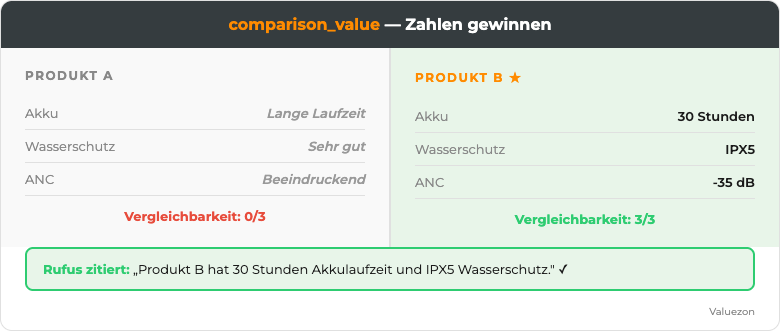
Fig. 4: Comparison Value in action: Rufus quotes listings with clear differentiation in comparison answers. Source: Valuezon 2026
💡 Tip: Write a “Who is this for?” and “Who is this NOT for?” analysis. The answers belong in your listing, implicitly or explicitly. Clear positioning is not a disadvantage. It’s a Rufus-native strength.
Factor 9: Match the Search Intent (intent_alignment)
A customer searching for “best headphones for home office” wants advice and comparison. Someone searching for “buy headphones” is on a transactional mission. Rufus recognizes the difference and prefers listings that fit the respective intent. Scoring: 0 = intent completely ignored, 3 = listing covers all main intents.
Before/After Example:
Before (Missed Intent, transactional for advisory search query): “Buy now and benefit from fast delivery! Top ratings, lowest price!”
After (Intent-aligned, informational/advisory): “Why this headphone for home office? ANC strength over sound quality, 32h battery for long work days, foldable for the commute to the office. The three factors remote workers mention most often.”
The second text responds to an advisory query and is preferred by Rufus for home office comparison questions.
💡 Tip: Analyze the top 5 queries you want to be found for. Which are informational, which are transactional, which are comparative? Your listing needs content for each of these types, ideally in clearly separated sections.
Factor 10: The Ground Truth (highest individual factor) (review_alignment)
At a glance:
- For Rufus, reviews are the most important external source of truth, above any listing claim.
- Contradictions between listing and reviews massively reduce the score.
- Review alignment means: Your listing describes the product the way customers experience it.
- Scoring: 0 = listing contradicts reviews, 3 = perfect alignment.
- Highest individual factor in Rufus scoring.
This factor is the most important of the ten. And the most frequently underestimated. Rufus treats customer reviews as the ground truth: the most reliable information about a product that exists. Not what the manufacturer claims. What hundreds of buyers have confirmed.
Rufus continuously compares your listing with the review content. If you promise “best sound in its class,” but most reviews say “okay for the price, nothing more,” Rufus will rate your listing as unreliable.
Does the second sentence sound less convincing? Maybe so. But Rufus quotes it far more often because it’s credible.
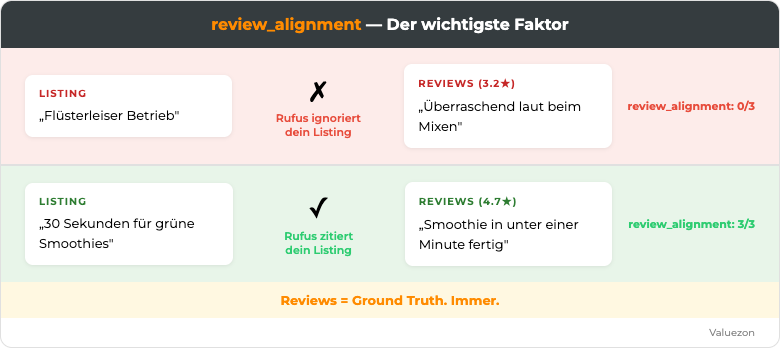
Fig. 5: Review Alignment is the single strongest factor: Rufus checks every listing statement against the reality of the reviews. Source: Valuezon 2026
💡 Tip: Read your top 50 reviews and identify the three most frequent positive and three most frequent negative key points. Your listing should address the positives. You can either clearly limit the negatives (“not suitable for X”) or transparently state them as known limitations. An honest listing will always outperform an over-optimized one with Rufus.
Practical Example: Analyzing a Listing Using All 10 Factors
At a glance:
- Product: Bluetooth headphones “SoundMax Pro X” (fictional example, consistent with Blog 4).
- Analysis: All 10 Rufus factors with current score (0 to 3) and recommended action.
- Before score: 11/30, After score: 26/30.
- Time required: approx. 3 to 4 hours for a full listing rewrite.
Initial Situation: The “Before” Listing (SoundMax Pro X)
Title: SoundMax Pro X Bluetooth Headphones with ANC and HiFi Sound
Bullet 1: Revolutionary next-generation ANC system Bullet 2: 40 mm neodymium drivers with extended frequency range Bullet 3: Powerful battery for hours of music enjoyment Bullet 4: High-quality materials and ergonomic design Bullet 5: Compatible with iOS and Android
Factor-by-Factor Analysis
| # | Factor | Current Score | Problem | Immediate Action |
|---|---|---|---|---|
| 1 | question_answer_quality | 0/3 | No bullet answers a question | Start each bullet with an implicit question |
| 2 | feature_specificity | 1/3 | “Hours” instead of number of hours, no Hz value | Support all features with numbers |
| 3 | trust_signals | 0/3 | No certificates, warranty or social proof | Warranty, ratings aggregate, if applicable certificate |
| 4 | multimodal_support | 1/3 | Only studio photos, no context | Lifestyle pictures for every main feature |
| 5 | conversational_fit | 1/3 | “Revolutionary” and “next generation” are buzzwords | Replace adjectives with statements |
| 6 | context_completeness | 1/3 | Only implied “for music”, no use cases | Name at least 4 scenarios of use |
| 7 | clarity_of_benefit | 1/3 | Features present, benefits missing | Add customer benefit to each feature |
| 8 | comparison_value | 1/3 | No positioning, no “for whom” | Name target group and differentiation |
| 9 | intent_alignment | 2/3 | Transactional language, little guidance | Advisory wording for research queries |
| 10 | review_alignment | 3/3 | Reviews confirm “good bass, long battery” | Explicitly highlight bass and battery life |
Previous total score: 11/30 (weak)
The “After” Listing (Post-Revision)
Title: SoundMax Pro X: 32h ANC Headphones for Home Office & Commuters, IPX5, foldable
Bullet 1: Yes, suitable for the home office: ANC reliably filters out air conditioner, keyboard, and conversation noise. So you can concentrate for 8 hours without needing to combine with earplugs.
Bullet 2: 32 hours battery life (ANC active). 10 minutes quick charge = 3 hours of music. Enough for 2 full workdays without a charging cable.
Bullet 3: 2 years warranty + TÜV-certified wearing comfort: Over 12,000 verified buyers rate the headphones an average of 4.6 stars, especially for long-term comfort.
Bullet 4: For commuters and remote workers, not for audiophiles: Bass-heavy, rich sound for pop, hip-hop, and podcasts. If you want reference sound, you’ll need a different model.
Bullet 5: All scenarios covered: Home office (ANC), commuting (foldable, 32h), sports (IPX5 splash protection), travel (airplane adapter included). Compatible with iOS, Android, and all Bluetooth 5.0 devices.
After Scoring
| # | Factor | After Score |
|---|---|---|
| 1 | question_answer_quality | 3/3 |
| 2 | feature_specificity | 3/3 |
| 3 | trust_signals | 3/3 |
| 4 | multimodal_support | 2/3 |
| 5 | conversational_fit | 3/3 |
| 6 | context_completeness | 3/3 |
| 7 | clarity_of_benefit | 3/3 |
| 8 | comparison_value | 2/3 |
| 9 | intent_alignment | 2/3 |
| 10 | review_alignment | 2/3 |
| Total | 26/30 |
After total score: 26/30 (excellent). From 11 to 26 through structured rewriting, without a single new keyword.
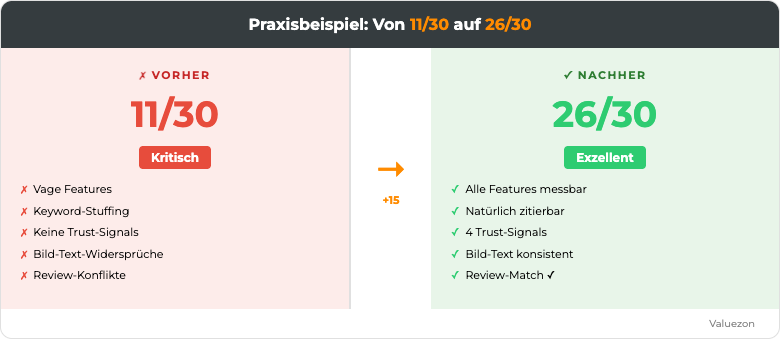
Fig. 6: Practical example SoundMax Pro X: Score jump from 11/30 to 26/30 due to structured rewrite. Source: Valuezon 2026
Self-Check: Your Rufus Readiness Scoring
Maximum score: 30 points (each factor 0 to 3). Honestly evaluate your own listing. A realistic current score is the foundation for effective revision.
Rufus Readiness Scoring Table
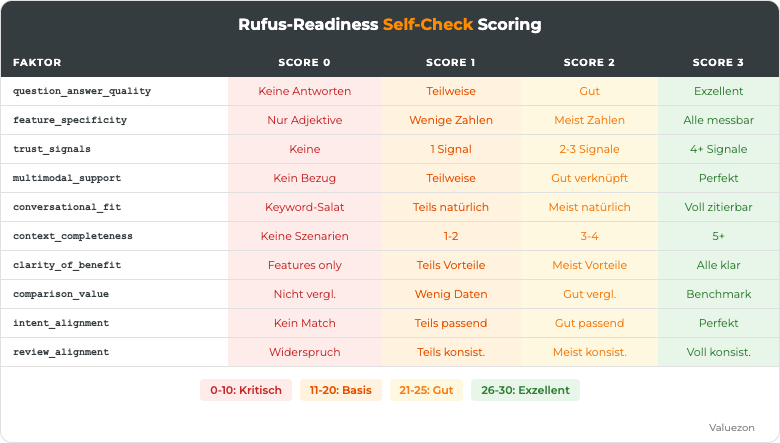
Fig. 7: The Rufus Readiness Self-Check: 10 factors, 30 possible points. Where does your listing stand? Source: Valuezon 2026
Evaluation Scale
| Score | Status | What it means |
|---|---|---|
| 0 to 10 | Critical | Rufus largely ignores your listing. Urgent revision needed. |
| 11 to 20 | Basic | Rufus finds occasional answers. Targeted improvements bring quick wins. |
| 21 to 25 | Good | Regular citations. Fine-tuning for the weakest factors. |
| 26 to 30 | Excellent | Rufus-native listing. Continue Monitoring and Review Alignment. |
Next step: With the Rufus Score (max. 30) and the COSMO Score from Blog 4 (max. 15), you have your complete Boost^AI Score (max. 45 points). In Blog 6 (Multimodal Listing Design), we’ll dive deep into Factor 4,
multimodal_support, and show you how to design images, A+ Content, and videos as integrated Rufus signals.
Outlook: Alexa for Shopping is Coming
Amazon is expanding its voice assistant Alexa with AI-powered shopping: Alexa recommends products, answers purchase questions, and guides purchase decisions through conversation—similar to Rufus, but via voice. Alexa for Shopping has not yet launched in Germany, but the start is foreseeable. The good news: Anyone who optimizes their listing today according to the 10 Rufus factors is automatically prepared. Answer quality, statements supported by numbers, and review alignment are exactly the signals a voice assistant needs to reliably recommend your product.
Frequently Asked Questions about Rufus Factors
What exactly are the Rufus factors, and where do they come from?
The 10 Rufus factors are Valuezon’s own conceptualizations. We developed them based on publicly available Rufus architecture documentation, observable citation patterns, and systematic A/B tests with revised listings. They describe which characteristics of a listing increase the likelihood of being cited by Rufus. Amazon itself has not released an official list of internal weighting parameters.
Which of the 10 Rufus factors has the strongest impact?
review_alignment (Factor 10) shows the highest individual effect in our analyses. Rufus treats verified customer reviews as ground truth—the most reliable source of information about a product. A listing that contradicts its own reviews will be systematically downgraded, no matter how strong the other nine factors are. In second place is question_answer_quality: Rufus generates answers, so it prefers listings structured as answers.
What is the difference between COSMO relations and Rufus factors?
The 15 COSMO relations (Blog 4) describe the semantic knowledge network Amazon builds around your product. What does Amazon know about your product, its features, target groups, uses? The 10 Rufus factors describe the quotability quality of your listing: How well is the knowledge prepared so Rufus can use it as an answer? In short: COSMO = knowledge base, Rufus factors = presentation quality.
How can I check my Rufus Readiness Score myself?
With the scoring table in this article, you can rate each of the 10 factors on a scale from 0 to 3. Read your listing critically and apply the stated criteria. Comparison with the practical example (SoundMax Pro X) helps with assessment. For an external evaluation, we offer the Boost^AI Score as a free analysis; the link is provided in the CTA section above.
How often should I check the Rufus factors?
We recommend checking review_alignment (Factor 10) monthly. Reviews change quickly, and a growing number of reviews can shift consistency. You should review the other nine factors whenever you significantly revise your listing, but at least quarterly. Rufus is a learning system. Citation weightings can shift—especially after product launch updates and seasonal changes in buying behavior.
Sources
- Amazon About: Rufus, AI-powered Shopping Assistant
- AWS Machine Learning Blog: Amazon Product Knowledge Graph (COSMO Architecture)
- Amazon Science: COSMO, Large-Scale E-Commerce Common Sense Knowledge System
- Fortune: Amazon Rufus, What the AI Shopping Assistant Does (Feb. 2024)
- Search Engine Land: Amazon Rufus SEO Impact
- Jungle Scout: Amazon Rufus Guide for Sellers
- Amazon Ads: Consumer Insights
Next article in this series: Blog 6, Multimodal Listing Design. How to design images, A+ Content, and videos as integrated Rufus signals. Coming end of June 2026.