
Your A+ Content is no longer just a gallery of images—it’s a brand-verified data source that Amazon’s AI uses to generate its purchase recommendations.
Most sellers treat their A+ Content like a brochure: attractive images, a touch of branding, done. That’s a thing of the past. Now that Amazon’s AI assistant not only indexes but actually reads and interprets product pages, your A+ Content is a structured data source that directly feeds into purchase recommendations. Structuring your modules so that the AI can understand them not only boosts your conversion rate, it also increases your chance of even being mentioned in an AI-powered answer.
Amazon quantifies the impact: Basic A+ Content can increase sales by up to 8 percent, Premium A+ Content by up to 20 percent. These figures are from before the age of AI search. With Rufus serving as the initial recommendation layer, the content properly processed by AI becomes the real ranking factor.
Key Takeaways at a Glance
- A+ Content is your brand-verified, structured first-party source: Rufus pulls your specs from here. Reviews and Q&A act as a ground-truth cross-check—your A+ Content must be consistent with them.
- Amazon quantifies the sales lift at up to 8% (Basic) or 20% (Premium), even before factoring in the AI effect.
- Text modules are fully processed; image-text is only partially captured: Critical details should always appear as true text within the module.
- The comparison table module is the most effective tool for teaching the AI your product’s relative value, and can only be used for items from the same brand.
- Rufus operates multimodally and, according to patent analysis, also processes text within images; for key purchase information, real text still takes priority.
- Since May 2026, Rufus is called Alexa for Shopping in the US; function and data logic remain identical. In Germany, the interface will continue as Rufus for now.
1. How Rufus Reads and Weighs A+ Content
Amazon’s AI reads your detail page as a collection of claims and cross-checks them against your reviews and Q&A before recommending your product. A+ Content holds a unique position: It’s a brand-verified, structured first-party source where you teach the AI your specs. Reviews and Q&A act as a ground-truth check—they confirm or contradict what you state. The leverage isn’t about outshining reviews, but about creating machine-readable facts in your A+ Content that are consistent with what’s in your reviews and Q&A. Discrepancies between your data and the reviews present the real ranking risk.
Here’s a business-impact example: A customer asks Rufus for an espresso machine that can also steam milk. The AI checks titles and bullet points first. If your A+ Content contains a text module mentioning a steam wand with a professional nozzle for fine-foam milk, it registers a brand-validated attribute. This specific detail determines whether your product appears in the AI’s answer—or if the AI recommends a competitor instead.
The key takeaway for your strategy: A+ Content should be read as informative, not promotional. Rufus searches the modules for specifications, use cases, and factual details—not for superlatives. Treat it as a technical manual the AI will query, not as a design showcase for customers to skim.
2. The Data Hierarchy: Where A+ Content Ranks
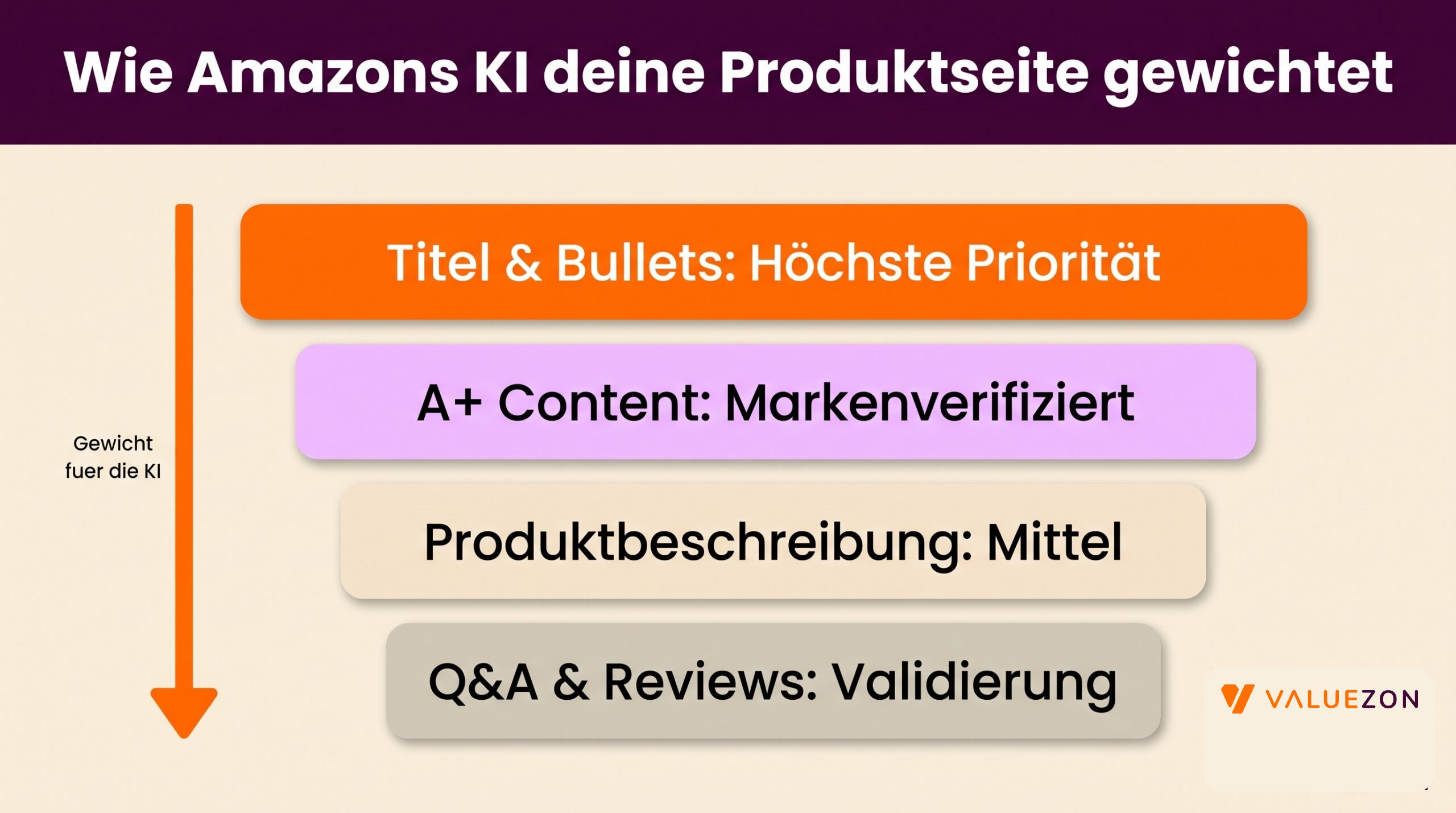
A+ Content is important, but it doesn’t replace higher-value data points. Amazon’s AI evaluates the signals from your product page in a clearly defined order, and if you put your efforts in the wrong place, you miss the true leverage.
Title and bullet points have the highest priority: they’re the first things the AI checks and are the most concise location for key buying attributes. A+ Content, as a brand-verified layer, comes directly afterward to supply context that titles and bullets can’t provide due to character limits. The description further elaborates. Important: Q&A and reviews aren’t lower-value—they’re the ground-truth instances the AI uses to cross-verify your brand-provided details. Your task: ensure your titles, bullets, A+ Content, and descriptions tell a consistent, fact-based story supported by the reviews.
3. Text Modules vs. Image Modules: What the AI Really Captures
The most important lever in A+ Content is deciding which information to present as text and which as an image. Rufus deeply scans the text modules in Premium A+ Content to find specs not included in the bullets. Any text you enter as actual text in the module is fully processed and coded into the semantic space of the AI. Most sellers miss this because people tend to skim A+ Content, but the AI actually reads it.
Image modules are a tougher case for the AI. Pure visuals without text offer little usable signal. That’s why the rule is: if a detail is critical to the buying decision, enter it as real text in the module. If the information only appears as a graphic in an image, processing isn’t guaranteed. Always duplicate key purchasing facts—like dimensions, materials, compatibility, and variants—as readable text.

4. Using Image Text and Multimodal Processing Correctly
Amazon’s AI is multimodal, and patent analysis indicates Rufus also processes image content. Text overlays in your A+ images can therefore be recognized as signals. However, this capability can’t be reliably confirmed from the outside, so the best practice is: Anchor your purchase-critical statements to outcomes you can observe, not just an assumed recognition rate. Anything the AI absolutely needs to process goes in as real text in the module—anything extra in the image is a bonus, not a replacement.

Subscribe to our newsletter and get fresh updates every two weeks.
5. Comparison Tables: The Strongest Module for AI
The comparison table module is the most effective tool for teaching Amazon’s AI the relative value of your product. Tables provide the AI with structured data in the exact format it best processes: row by row, column by column. A table with columns like model, size, weight, and battery life automatically signals to the AI that there are several variants with differing features.
| Model | Size | Weight | Battery Life |
|---|---|---|---|
| Basic | 8 × 5 cm | 150 g | 8 hours |
| Plus | 10 × 7 cm | 220 g | 15 hours |
It’s important to follow Amazon’s rule: comparison tables are intended for products of the same brand and must not be used for direct competitor comparisons. If you sell multiple variations, you’re missing out on the strongest signal A+ Content can provide to the AI unless you use this module.
6. Brand Story as a Trust Signal for Your Brand
The Brand Story module is read by the AI as providing brand context and serves as a trust signal. Unlike product-specific modules, it impacts the entire brand. If your brand story clearly states your origins, such as “founded in 2015 by German engineers focusing on durable technology,” the AI links this context directly to your overall brand. The strategic value becomes clear when expanding your product range: if you launch a product in a new category later, the brand context is already established.
7. The Five Most Common A+ Mistakes That Slow Down the AI
- Keyword stuffing: Unnatural repetition is read by the AI as a spam signal, not as relevance.
- Imbalance between images/text: Three to five image modules with substantial text outperform ten modules with decorative images.
- Contradictory data sources: If the title and A+ Content disagree on product performance, it creates a conflict the AI can’t resolve.
- Poor image quality: Blurry graphics reduce the chances that text within images will be processed.
- Purely promotional tone: A+ Content that reads like a sales brochure provides the AI with few extractable facts.
8. Checklist: Is Your A+ Content Rufus-Ready?
These twelve points form the foundation for Amazon’s AI to accurately process your A+ Content. Work through the checklist for your top listings, implement two or three quick improvements, and monitor the results over four weeks.
- All sentences are grammatically correct and written in clear, informative language.
- No keyword is repeated more than three times.
- At least one or two comparison tables for your variations.
- All images sharp and high-resolution (at least 1000 × 1000 px).
- Text in images appears dark on a light, uncluttered background.
- Font size in image text is sufficiently large and sans-serif.
- No contradictions between title and bullet points.
- Brand story is precise, fact-based, and about 150 to 300 words long.
- All product variations are listed with their attributes.
- Purchase-relevant facts are presented as real text, not just in images.
- A+ Content updated within the last six months.
- At least one module addresses a concrete customer pain point.

Your action plan: Open the A+ Content for your one to three highest-revenue listings. Work through the 12-point checklist and highlight any gaps. Implement the two or three most effective improvements right away—most often, this will be adding a comparison table, plus converting purchase-relevant image details into real text.
Find Out How KI-Ready Your A+ Content Is
Your A+ Content plays a key role in whether Amazon’s AI understands and recommends your product. The free Boost^AI Score Check from Valuezon evaluates your listing on 25 points: 15 COSMO relations for semantic knowledge graph quality and 10 Rufus factors for conversational AI readiness. In just a few minutes, you’ll see where your A+ Content is invisible to the AI and which modules have the biggest impact.
Frequently Asked Questions on A+ Content and Rufus
How does Amazon’s Rufus read A+ Content?
Rufus reads A+ Content as a brand-verified, structured first-party source and uses the text modules to extract your specs. Reviews and Q&A serve as a ground-truth cross-check, with which your A+ Content must be consistent. Text modules are fully captured and encoded into the AI’s semantic space; image content is processed multimodally but less reliably. Therefore, purchase-relevant facts should always be presented as actual text within the module.
Are comparison tables in A+ Content important for AI?
Yes. The comparison table module is the most effective tool to teach AI the relative value of your products, because tables provide structured data in a machine-readable format. However, they are only allowed for products of the same brand—not for competitor comparisons.
Should I place information as text or as an image in the A+ Content?
Purchase-relevant details such as dimensions, materials, or variants should always be included as real text in the module, as this is fully captured. Images provide visual buying appeal, but do not replace textual information.
How much impact does optimized A+ Content actually have?
Amazon estimates the sales uplift at up to 8 percent for Basic and up to 20 percent for Premium A+ Content. These figures are from before the AI-powered search; with Rufus as a preceding recommendation layer, well-structured content has become even more important.
Is Rufus now called Alexa for Shopping?
In the US, Amazon renamed the assistant to Alexa for Shopping in May 2026. Functionality, data sources, and recommendation logic remain unchanged. In Germany, the interface is still called Rufus at this time.